BESS 101 – Overview of Battery Energy Storage Systems (BESS) in India
India’s transition to a clean energy future is accelerating, with ambitious targets to expand renewable capacity and reduce carbon emissions. However, the increasing share of solar and wind power in the energy mix brings a new challenge — their variable and unpredictable nature. Battery Energy Storage Systems (BESS) have emerged as a critical solution to store surplus renewable energy and deliver it when needed, ensuring grid stability, reliability, and round-the-clock power supply.
What are Battery Energy Storage Systems (BESS)?
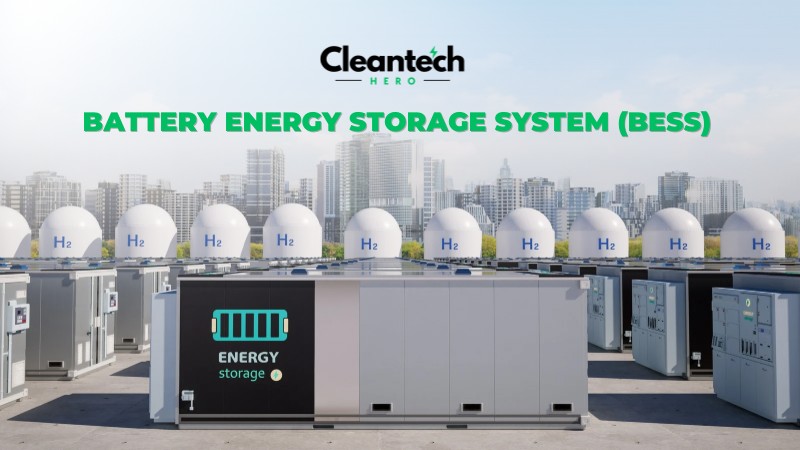
Battery Energy Storage Systems (BESS) refer to a technology that stores electrical energy in chemical form using rechargeable batteries and releases it when needed, functioning like a large-scale power bank. These systems play a crucial role in balancing power supply and demand, integrating intermittent renewable energy sources such as solar and wind, and enhancing the stability and reliability of the power grid.
BESS can be deployed across various applications:
- Utility-scale projects for grid balancing and renewable energy integration.
- Commercial and industrial (C&I) installations to manage peak demand and reduce electricity costs.
- Residential use for backup power and rooftop solar storage.
- In electric vehicle (EV) battery packs, which can also be repurposed for stationary storage.
Why India Needs BESS
India’s energy transition goals are ambitious — 500 GW of non-fossil fuel-based capacity by 2030 and net-zero emissions by 2070. Over half of this capacity is expected to come from solar and wind power, which are variable and non-dispatchable.
This variability poses challenges for grid stability, making energy storage solutions essential. BESS can address these challenges by:
- Storing excess energy generated during periods of low demand.
- Providing energy during peak hours or when renewable generation dips.
- Enabling round-the-clock renewable energy (RTC RE) supply.
- Supporting grid services such as frequency and voltage regulation.
- Deferring costly transmission and distribution upgrades by balancing local supply and demand.
Current Status of BESS in India
While still at a nascent stage compared to global leaders, India’s BESS sector is showing signs of rapid growth, supported by policy measures, tenders, and private sector investment. The government has launched one of the largest programmes in the sector globally.
According to official estimates, India will require about 411.4 GWh of storage by 2032 (236.22 GWh BESS and 175.18 GWh PSP), with the sector projected to attract ₹4.79 lakh crore investment. [Where PSP stands for Pumped Storage Projects (or Pumped Storage Plants)]
The Ministry of Power has announced new measures to accelerate deployment of grid-scale energy storage in India.
The government has extended financial support for 43 GWh of Battery Energy Storage Systems (BESS) development through the Viability Gap Funding (VGF) scheme. In fact, financial support of Rs 9,160 Cr has been earmarked for BESS VGF schemes. This is expected to attract more than ₹33,000 crore investment by 2028 as per government estimates.
Recently, a 5 GWh annual BESS manufacturing facility was inaugurated in Bengaluru, which will be one of the largest facilities in the country that will strengthen domestic production capacity.
To improve project economics, the government has fully waived Inter-State Transmission System (ISTS) charges for co-located BESS projects commissioned by June 2028.
Officials highlighted that energy storage will be critical for renewable energy integration, grid stability, peak load management, and ancillary services, enabling India to progress towards its 2030 targets of reducing emissions intensity by 45% (from 2005 levels) and achieving 50% cumulative capacity from non-fossil sources.
Challenges of BESS
While Battery Energy Storage Systems hold immense promise for strengthening India’s renewable energy transition, the journey toward large-scale adoption is not without obstacles. Deploying BESS at utility, industrial, and residential levels requires overcoming a range of technical, economic, policy, environmental, and operational hurdles. These challenges influence not only the pace of deployment but also the long-term sustainability and viability of storage solutions. Below is an overview of the key issues shaping the sector.
Here’s a structured overview:
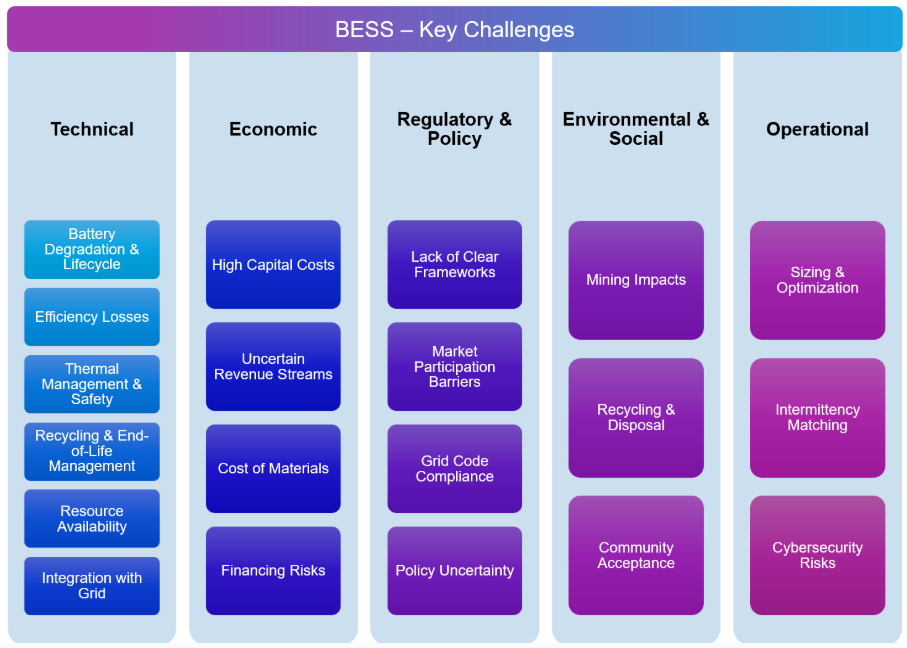
Technical Challenges
1. Battery Degradation & Lifecycle
- Batteries lose capacity over time as ions move between electrodes, causing chemical and structural changes.
- Fast charging, high operating temperatures, and deep discharge cycles accelerate degradation.
- For example, lithium-ion cells used for grid storage may last 8–10 years, while utility projects typically need 15–20 years of reliable service.
2. Efficiency Losses
- Round-trip efficiency (charging → storing → discharging) is typically 80–90%.
- This means 10–20% of stored energy is lost due to internal resistance, thermal effects, and power electronics conversion.
- At large scales, this loss affects economics and overall grid efficiency.
3. Thermal Management & Safety
- Lithium-ion batteries are prone to overheating and “thermal runaway,” which can cause fires or explosions.
- Large BESS installations highlight safety risks (e.g., Tesla Megapack fires in Australia and California).
- Effective cooling, fire suppression systems, and advanced Battery Management Systems (BMS) are essential.
4. Recycling & End-of-Life Management
- Current recycling technologies recover only part of lithium, cobalt, and nickel.
- Recycling infrastructure is limited and costly, making it difficult to process large volumes of retired batteries.
5. Resource Availability
- Lithium, cobalt, and nickel supply chains are concentrated in specific regions (e.g., cobalt in the Democratic Republic of Congo, lithium from Austrakia and South American countries like Chile, and nickel from places like Indonesia and Philippines).
- Supply risks, geopolitical issues, and ethical mining practices (child labor, environmental damage) add challenges.
6. Integration with Grid
- BESS must coordinate with existing grid infrastructure to provide services like frequency regulation, voltage stabilization, and peak shaving.
- This requires sophisticated control software and interoperability standards, which are still evolving.
Economic Challenges
1. High Capital Costs
- Utility-scale BESS projects require significant upfront investment in batteries, inverters, land, and safety systems.
- Although costs are falling (lithium-ion dropped ~90% in the last decade), they remain high compared to traditional energy sources.
2. Uncertain Revenue Streams
- Unlike solar or wind projects (which earn revenue from energy sales), BESS earns revenue from multiple smaller streams—like grid balancing (helping stabilize the electricity grid), peak shaving (supplying power during high-demand hours to reduce stress on the grid), or energy arbitrage (buying electricity when it’s cheap like during low demand and selling it when prices are higher).
- These revenue models are often volatile or limited in certain markets.
3. Cost of Materials
Battery prices are directly linked to global commodity prices. For example, spikes in lithium or nickel prices can significantly increase costs.
4. Financing Risks
- Investors worry about technology obsolescence (e.g., shift from lithium-ion to sodium-ion or solid-state).
- The mismatch between battery life (8–10 years) and project financing timelines (20–25 years) also complicates investment.
Regulatory & Policy Challenges
1. Lack of Clear Frameworks
- In India, the regulatory status of Battery Energy Storage Systems is still being formalized. According to the Ministry of Power’s 2022 guidelines, BESS can be classified as part of generation, transmission, or distribution systems depending on where and how they are deployed.
- Moreover, draft state-level regulations (such as by APERC) explicitly support these multiple classification pathways.
- This evolving regulatory framework creates uncertainty around licensing, charge assignments, and tariff structures, which in turn complicates project planning and economics for both developers and utilities.
2. Market Participation Barriers
India has opened its electricity markets to Battery Energy Storage Systems through recent regulatory reforms. The Central Electricity Regulatory Commission (Ancillary Services) Regulations 2022 formally recognize BESS as eligible to participate in frequency control, reserves, and other ancillary services. The Ministry of Power’s guidelines for BESS procurement have also created pathways for market participation.
However, operational challenges remain. Requirements such as advance declaration of State of Charge (SoC), coordination with system operators, and evolving dispatch procedures can limit smooth participation. These factors continue to create uncertainties for developers and may affect the ability of storage projects to fully monetize their capabilities.
3. Grid Code Compliance
India follows the Indian Electricity Grid Code (IEGC) 2023, which sets uniform technical standards for grid integration, interconnection, and protection across all regions. While the framework is consistent nationwide, BESS developers still face challenges in interpreting and implementing these standards at the state and project level, which can affect approval timelines and project scaling.
4. Policy Uncertainty
- Incentives (like subsidies, tax benefits, or viability gap funding) are not consistent and may change with political priorities.
- Developers face risks if policies shift mid-project.
Environmental & Social Challenges
1. Mining Impacts
- Extraction of lithium, cobalt, and nickel involves water-intensive processes, soil degradation, and habitat destruction.
- Cobalt mining, in particular, has raised concerns over child labor and unsafe working conditions.
While India does not mine most of these critical minerals, its BESS deployment plans rely on global supply chains. Therefore, environmental and social concerns associated with lithium, cobalt, and nickel extraction have indirect implications for India’s storage ecosystem, including costs, supply security, and sustainability.
2. Recycling & Disposal
- If not handled properly, retired batteries may release toxic chemicals, posing environmental hazards.
- A large wave of end-of-life batteries is expected in the coming decade, raising urgent recycling concerns.
3. Community Acceptance
- Local communities may oppose large BESS projects due to fears of fire hazards, land use conflicts, or visual impacts.
- For example, residents near grid-scale storage installations in the US and UK have raised safety objections. Incidents like the 2025 California fire and a 2020 Liverpool blaze have fueled these concerns, leading to local protests, legislative proposals for tighter regulation, and calls to locate such facilities in remote areas away from homes and businesses.
Operational Challenges
1. Sizing & Optimization
- Determining the right size (MW capacity and MWh duration) is tricky—too small, and it won’t serve grid needs; too large, and it becomes uneconomical.
- Applications vary: short-duration (frequency regulation, <1 hour) vs. long-duration (load shifting, >4 hours).
2. Intermittency Matching
- Renewable energy is variable (solar in daytime, wind at night), and storage must match these fluctuations.
- Incorrect matching leads to underutilization or insufficient backup.
3. Cybersecurity Risks
- BESS relies on software-controlled Battery Management Systems (BMS) and grid interconnections.
- As with any digital infrastructure, they are vulnerable to hacking, malware, or system failures, which could destabilize the grid.
BESS technology is critical for renewable integration but faces multi-layered challenges—from technical degradation, safety risks, and resource dependency to policy gaps, high costs, and environmental concerns. Solutions will likely involve technology diversification (sodium-ion, flow batteries), stronger recycling infrastructure, clear policies, and integrated safety frameworks.
Sources
- https://www.pib.gov.in/PressReleasePage.aspx?PRID=2135450
- https://www.pib.gov.in/PressReleseDetailm.aspx?PRID=2152471
- https://www.pib.gov.in/PressReleasePage.aspx?PRID=2140223
- https://thesecretariat.in/article/india-s-battery-storage-rollout-struggles-to-gain-momentum
- https://www.pib.gov.in/PressReleseDetailm.aspx?PRID=2089056
- https://mnre.gov.in/en/energy-storage-systemsess-overview/
- https://documents1.worldbank.org/curated/en/099536501202316060/pdf/IDU0edcfc32c0825f040f509c0b0bbf49294e569.pdf
- https://powermin.gov.in/sites/default/files/uploads/RS21032023_Eng.pdf
- https://ieefa.org/sites/default/files/2025-04/The%20Standalone%20Energy%20Storage%20Market%20in%20India_April%202025.pdf
- https://www.derc.gov.in/sites/default/files/Order%20in%20Petition%20No.%2044_2025_BRPL_in%20principle%20approval_BESS%20%281%29.pdf#:~:text=e.%20The%20proposed%20Shivalik%20Grid%20BESS%20is,in%20the%20context%20of%20increasing%20VRE%20penetration.
- https://powermin.gov.in/sites/default/files/National_Framework_for_promoting_Energy_Storage_Systems_August_2023.pdf
- https://www.niti.gov.in/sites/default/files/2019-10/ISGF-Report-on-Energy-Storage-System-%28ESS%29-Roadmap-for-India-2019-2032.pdf
- https://www.sciencedirect.com/science/article/pii/S1364032123002575
- https://www.bbc.com/news/uk-england-leeds-66584335
- https://www.edina.eu/power/battery-energy-storage-system-bess
Also read: Battery Energy Storage in India: Geon’s Strategy, Localization, and Policy Outlook
Subscribe to our Newsletter
Subscribe today for free and stay on top of latest developments in Cleantech domain.