
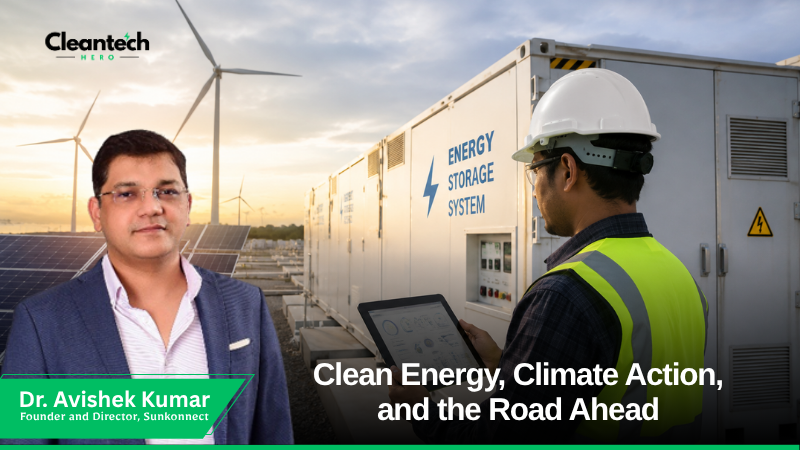
Managing Quality from Manufacturing to Deployment in Renewable Energy
This article is authored by Dr. Avishek Kumar, Founder and Director of Sunkonnect, a Singapore-headquartered renewable energy and sustainability advisory firm providing ESG, net-zero, climate, carbon audit, and green building consulting services. He can be reached through Sunkonnect.
1. Where in the supply chain do you see the most quality failures: raw material sourcing, in-process manufacturing, pre-shipment, or post-installation?
Quality challenges can emerge at every stage of the supply chain, but in my experience, the most critical failures often surface during in-process manufacturing and pre-shipment. Raw material inconsistencies, especially in glass, EVA, or backsheet for solar modules, and steel quality for wind components, can set the stage for downstream issues. However, it is during in-process manufacturing that lapses in process control, inadequate traceability, or improper calibration of equipment tend to lead to structural or performance-related non-conformities. Pre-shipment inspections then become the last line of defence to catch such issues before deployment. Post-installation failures are rarer but can be severe, usually tied back to earlier lapses that went undetected. This is why a holistic quality assurance programme across the entire value chain is vital.
2. Solar and wind equipment is increasingly sourced from global manufacturers. How does Sunkonnect ensure inspection rigour when equipment is manufactured in, say, China, Vietnam, or Denmark before shipping to India?
Sunkonnect operates with a global network of technical experts and accredited inspection partners, allowing us to deploy independent teams at manufacturing facilities regardless of geography. Our approach combines rigorous on-site inspections with digital monitoring tools. We tailor our checklists to international and client-specific standards, focus on process audits, and conduct random sampling for destructive and non-destructive testing. For critical components, we also use data-driven analytics to flag anomalies in real time. This hybrid model, combining boots-on-the-ground expertise with digital oversight, ensures that quality and compliance are upheld even across complex, multi-country supply chains.
3. What are the most common deviations or non-conformities you encounter during pre-shipment inspections? Have you identified any recurring issues specific to Indian EPC projects?
During pre-shipment inspections, common deviations include inconsistencies in labelling, incomplete documentation, and minor cosmetic defects. More serious issues, such as improper lamination in solar modules, micro-cracks, or non-conformance to electrical safety standards, occasionally surface and require immediate corrective action. In the context of Indian EPC projects, we often observe gaps in adherence to project-specific specifications, as well as challenges with last-minute design changes or incomplete type testing. These issues are sometimes amplified by aggressive timelines and cost pressures. Early engagement with EPCs and suppliers, coupled with a robust documentation process, helps mitigate these risks.
4. There’s growing interest in BESS in India. How different is the inspection and quality assurance challenge for storage compared to solar PV or wind?
Battery energy storage systems (BESS) present a new layer of complexity compared to traditional solar or wind assets. The inspection scope expands beyond mechanical and electrical quality to include a deep dive into battery chemistry, thermal management, software controls, and safety protocols. Unlike solar modules, where visual inspection and electrical tests are standard, BESS requires cell-level traceability, end-of-line testing, and validation of software algorithms that manage charging, discharging, and fire suppression. Our teams undergo specialised training for BESS audits, and we place a strong emphasis on lifecycle testing and cybersecurity, given the integration with digital grids.
5. You’ve also co-founded VFlowTech (Vanadium Flow Batteries). How do you foresee the usage of vanadium batteries in a lithium-dominated BESS market?
Lithium-ion will remain the mainstream choice for short-duration, high-density applications, but vanadium flow batteries are gaining traction for grid-scale, long-duration storage due to their inherent safety, scalability, and ability to handle deep cycling without degradation. In markets like India, where renewable penetration is increasing and grid stability is crucial, vanadium flow batteries can complement lithium systems by providing long-duration backup, frequency regulation, and integration with renewable assets. As costs decline and local supply chains for vanadium mature, I believe we will see a hybridisation of storage portfolios, with vanadium flow batteries playing a key role in large-scale and industrial applications.
6. With the rise of domestic solar manufacturing under the PLI scheme, do you see Indian manufacturers improving quality benchmarks, or is there still a significant gap compared to global standards?
The PLI scheme has catalysed significant investments in automation, R&D, and process upgrades among Indian manufacturers, and we are witnessing genuine improvements in quality benchmarks, particularly among Tier 1 players. India’s solar module manufacturing capacity has grown remarkably — exceeding 120 GW as of mid-2025, representing over 200% growth since 2022. However, it is equally important to acknowledge that implementation has not been without challenges. Capacity additions in certain upstream segments remain below targets, and manufacturers continue to navigate dependencies on imported equipment, raw materials, and technical expertise. Bridging the gap with global leaders will require sustained focus on process discipline, workforce training, and ongoing investment in advanced testing infrastructure. The most successful manufacturers are those who embed quality into their organisational culture, not just their production lines. With continued policy support, greater upstream integration, and industry collaboration, I am cautiously optimistic that Indian solar manufacturing will progressively move towards global parity.
7. Given that you’ve built battery analytics AI and IoT capabilities at your other venture, Datakrew, it would seem natural to bring those into Sunkonnect’s inspection work. Has that integration happened in practice, or do the realities of field inspection, remote sites, inconsistent connectivity, and client conservatism make it harder than it sounds?
We have made significant strides in integrating AI-driven analytics and IoT-based monitoring into Sunkonnect’s inspection and quality assurance processes, particularly in environments where connectivity and client readiness permit. For instance, our digital twin solutions and remote monitoring systems allow real-time tracking of equipment performance and predictive maintenance. However, adoption varies by region and project type. In remote sites with limited connectivity or where clients prefer traditional approaches, we adapt by using hybrid models, combining on-site inspections with periodic digital assessments. Change management and demonstrating clear ROI are key to driving wider adoption of these advanced tools across the sector.
8. What advice would you give to renewable energy developers to avoid quality pitfalls early in their projects?
Start with a quality-first mindset from day one. Engage experienced technical partners early in the design and procurement process. Insist on robust supplier qualification, independent testing, and clear documentation of standards. Invest in digital tools for traceability and real-time quality monitoring. Most importantly, create a culture of transparency and accountability across stakeholders — developers, EPCs, and suppliers alike. Early diligence, paired with ongoing oversight, will save time and cost in the long run, while ensuring that your assets deliver reliable and sustainable performance throughout their lifecycle.
Read more at: BESS: Replacing Diesel Gensets with Green Power Backup
Subscribe to our Newsletter
Subscribe today for free and stay on top of latest developments in Cleantech domain.


