
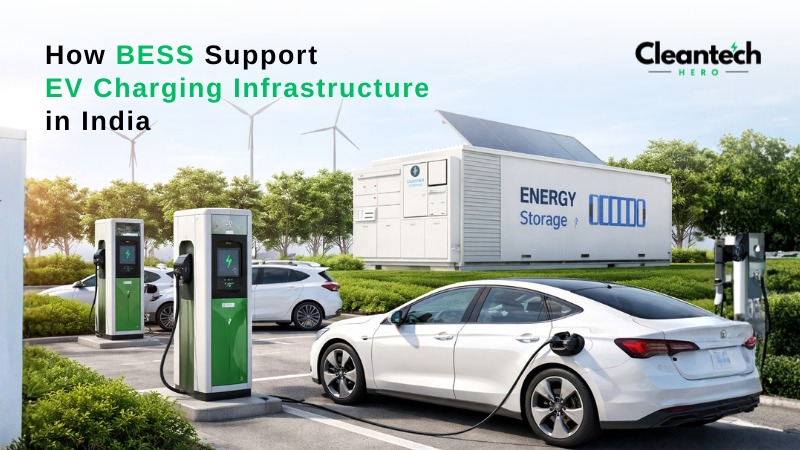
How Battery Energy Storage Systems (BESS) support EV charging infrastructure in India
As India expands its electric mobility ecosystem, the demand for reliable and affordable charging is one of the biggest operational challenges. Many charging operators face challenges related to grid capacity, power quality, and high operational costs. Battery Energy Storage Systems (BESS) are emerging as a practical solution to support the scale-up of EV charging, especially in areas where the electricity network is not equipped to handle high loads. This article outlines the role of BESS in EV charging infrastructure, highlights international examples, and discusses implementation pathways relevant to the Indian context.
Why EV charging needs additional support
Fast chargers, especially DC chargers above 30–60 kW, require a steady, high-power, three-phase AC supply from the electrical grid. In several urban and highway locations, the local distribution network does not have enough spare capacity to support multiple fast chargers. Upgrading transformers, feeders, or substations can take months and adds significant cost. In commercial locations, operators also face demand charges linked to peak power use, which increases operating expenses. These challenges slow down the rollout of public and fleet charging stations.
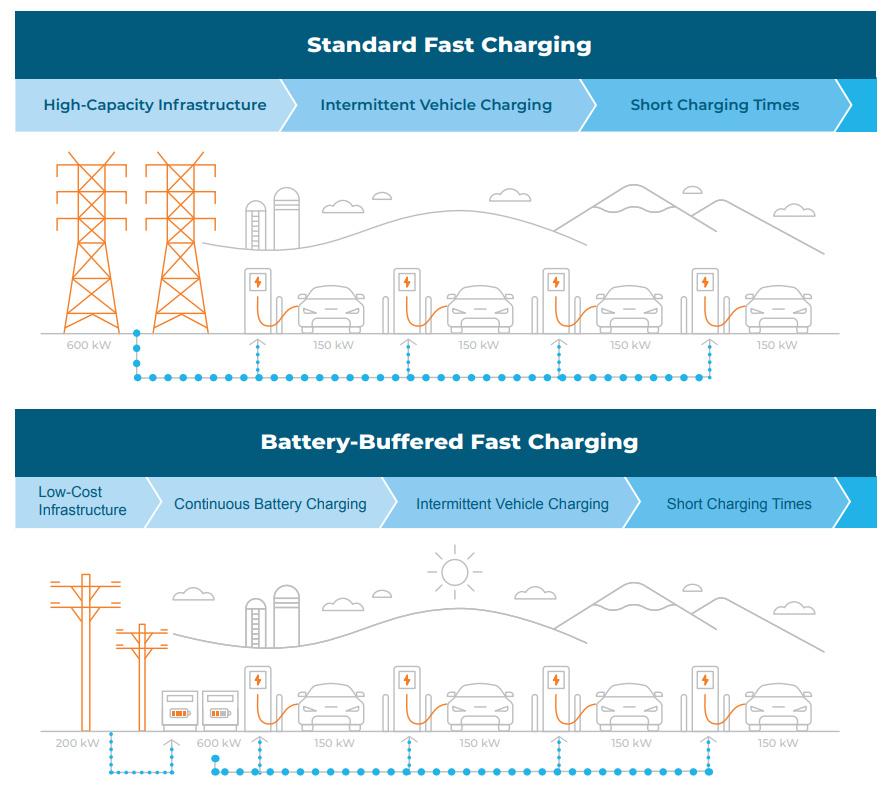
A BESS is a controllable pool of stored electricity. It can address many of these constraints by supplying stored energy when demand is high and drawing energy from the grid when demand is low. This makes EV charging stations more flexible and helps operators deliver reliable services without waiting for major grid upgrades.
Industry solutions are already emerging in this space. For example, Exicom notes that integrating BESS with fast chargers allows sites to deliver high-power charging even where grid capacity is limited, while also supporting solar usage and smoothing peak loads. This reduces reliance on major grid upgrades and enables faster deployment of charging stations.
Pic source: The Joint Office of Energy and Transportation Report
Why India needs BESS at EV charging hubs
As charging demand grows across cities and highways, operators face power availability, cost, and reliability challenges. BESS helps address these issues by making fast-charging sites more flexible and grid-independent.
- Rapid charger roll-out vs limited local grid capacity — Fast chargers need a lot of power, but many city and highway locations don’t have enough grid capacity. A BESS can provide the extra power needed, so operators can install fast chargers without waiting for costly grid upgrades.
- Peak-demand cost savings — Commercial charging sites pay extra when their electricity use is very high. A BESS can help reduce these costs by using stored energy during busy times and charging itself when electricity is cheaper.
- Enabling renewable energy at chargers — Putting solar panels and a BESS together at a charging site allows the chargers to use clean energy more consistently. The battery stores solar power when it is available and supplies it when sunlight is low. This supports India’s clean energy and decarbonization goals.
ChargeZone is developing its first renewable-powered charging hub in Dahej, Gujarat, where a 1 MW solar plant will be paired with a 5 MWh BESS to run the site primarily off-grid and use the grid only as backup. This setup reduces dependence on local grid capacity, supports higher renewable usage, and ensures reliable fast charging.
Another example comes from Quench Chargers’ BESS-Assisted Energy Management System, which integrates grid power, onsite renewables, and a battery wall using a proprietary Energy Management System (EMS is a control platform—comprising software and hardware—that monitors, optimises, and controls energy flows between different sources and loads, coordinating grid power, renewable energy, and batteries to enable efficient and cost-effective EV charging). This solution improves power reliability at charging sites prone to outages, enables higher-capacity fast charging even when grid supply is limited, and helps reduce demand charges by intelligently managing energy flows.
How other countries are using BESS with EV charging
Several countries are already using BESS to support their EV charging networks, offering useful reference points for India.
- United States
In the U.S., many highway and retail charging operators use BESS as a buffer to reduce demand charges and avoid expensive grid reinforcements. Pilot projects have demonstrated that even moderate storage capacity can significantly lower operational costs.
Across the U.S., several operators are already using BESS to stabilise and expand EV charging.
– Electrify America has deployed storage at 150+ sites, with many in California operating as a virtual power plant to shift load to off-peak hours and reduce grid strain.
– Blink Charging uses BESS at a Philadelphia, Pennsylvania site to support four fast chargers and keep them running during outages.
– At Houston Airport, EverCharge and PassKey use BESS with SmartPower technology for efficient load management
– Penske’s California depot uses storage to ensure uninterrupted fleet charging during peak demand or grid failures.
Collectively, these examples show how BESS helps manage peak loads, reduce demand charges, improve reliability, and support clean-energy powered charging.
- Malaysia
Malaysia has demonstrated an effective model for highway fast charging by deploying BESS-backed high-power chargers at select highway rest areas. These sites use moderate battery capacities (a few hundred kWh) to support multiple 150 kW chargers in locations with limited grid infrastructure. The BESS supplies the extra power needed during peak charging sessions and recharges during off-peak periods, enabling reliable high-power charging even where direct high-capacity grid connections are not available.
Malaysia’s charging operators are actively using BESS to deliver fast charging in grid-limited areas.
– Gentari and EV Connection (Jom Charge) have installed 300 kWh BESS units alongside 150–200 kW chargers at several North–South Expressway laybys, often paired with on-site solar.
– chargEV has developed its own BESS technology to support fast charger rollout across retail and highway locations.
– REcharge (also known as RE Energy Sdn Bhd) integrates storage with solar to reduce grid dependence.
These deployments show how BESS enables high-power charging without costly or time-consuming grid upgrades.
- Europe
In several European countries, operators integrate BESS with charging stations and also offer ancillary services to grid operators when the storage system is idle. This allows the same asset to support both mobility and grid operations, improving overall project viability.
Several European countries are integrating BESS into fast-charging networks to manage high power demand and reduce dependence on costly grid upgrades.
– In Germany and Belgium, operators like Allego use storage to stabilise motorway charging sites, supported by favourable policies such as Germany’s grid-fee exemptions.
– The UK widely deploys BESS at charging stations where grid capacity is limited, backed by strong ancillary service markets.
– Italy’s capacity auctions allow BESS projects to secure long-term contracts of up to 15 years with fixed availability payments, while Terna’s Fast Reserve market offers additional revenue for ultra-fast frequency regulation services, creating diversified and stable income streams that strengthen the financial case for grid-scale BESS.
– Spain supports storage through a national strategy and zero grid tariffs for batteries.
– In the Netherlands, large solar and wind capacities create price volatility that enables profitable energy-arbitrage and balancing opportunities for BESS-powered charging hubs.
These examples show that BESS-enabled charging can solve local grid limitations, improve charging reliability, and diversify revenue for operators.
Implementation pathways for India
India can adapt various deployment models based on local needs and infrastructure readiness. Below are pragmatic, India-appropriate models ranging from small to large scale.
1. Urban multi-charger sites
Urban locations such as shopping centres, office complexes, and public parking areas often operate with limited sanctioned electrical load. Installing small to mid-scale BESS (typically 50–500 kWh) allows charging operators to store electricity during low-demand periods and discharge it during peak charging hours. This reduces peak load draw from the grid and enables the installation of multiple fast chargers without immediate distribution network upgrades.
2. Highway charging hubs
Long-distance travel requires high-power chargers at regular intervals. Larger BESS installations, generally in the range of 0.5–2 MWh, can supply short-duration high-power charging by buffering energy from the grid. This approach supports the development of EV charging corridors and reduces dependence on large transmission or substation upgrades, which typically involve longer lead times.
3. Fleet depots
Fleet depots serving electric buses, logistics vehicles, and last-mile delivery fleets operate on defined schedules with predictable charging demand. BESS can be used to shift charging to off-peak hours, limit peak demand from the grid, and improve reliability where grid capacity is constrained. This model is relevant for large fleet electrification programmes that require coordinated charging without overloading local distribution networks.
4. Aggregated or virtual power plant (VPP) model
Multiple BESS-enabled charging stations can be digitally aggregated and operated as a single resource. Such aggregation enables participation in grid-support functions, including peak load management and demand response, subject to regulatory approval. In India, the commercial viability of this model depends on evolving rules for energy storage participation in power markets and ancillary service mechanisms.
Policy, regulatory & business measures India should prioritise
To scale BESS-backed EV charging effectively, India needs coordinated policy and commercial signals:
1. Financial incentives / capex support for initial pilots — small grants, viability gap funding or low-cost loans for combined solar + BESS + charging pilots. These de-risks early projects.
2. Clear grid-interconnection / tariff treatment for BESS at charging sites — allow BESS to be registered for ancillary markets and avoid punitive distribution charges that undermine economics. The Ministry of Power EVCI guidelines (2024) already clarify charging operations; complementary BESS rules will help.
3. Demand charge reform or time-of-use (ToU) signals — ToU tariffs that reward off-peak charging improve the BESS business case.
4. Standardised procurement & performance contracts — templates similar to SECI’s (Solar Energy Corporation of India Limited) BESPA (Battery Energy Storage Purchase Agreement) will accelerate private investment and bankability. SECI’s large BESS tenders provide a procurement model to learn from.
5. Highway concession frameworks allowing private operators — allow concessionaires to monetize rest-area charging and BESS services (e.g., through availability payments or revenue-sharing).
Technical & safety considerations
- Right-sizing: match BESS energy (kWh) to expected charge throughput (sessions/day) and power (kW) to peak simultaneous charging.
- Thermal management, fire mitigation and standards: adopt international safety practices and ensure local installers are certified.
- Controls / EMS: an energy management system that orchestrates grid, BESS, solar and chargers is critical for reliability and revenue stacking.
Conclusion
Battery Energy Storage Systems (BESS) can support the expansion of India’s EV charging infrastructure by improving power availability, managing peak demand, and enabling greater use of renewable energy. Global deployments indicate that pairing fast chargers with storage can reduce grid constraints and improve reliability. With SECI-led BESS tenders, national EV and charging guidelines, and supportive tariff and market frameworks, India has an opportunity to pilot and scale BESS-backed charging hubs that are efficient, scalable, and aligned with long-term electrification goals.
Related source links
- https://www.seci.co.in/Upload/Tender/SECI000160-7915545-RfS-ESS-2-final_upload.pdf
- https://www.iea.org/reports/global-ev-outlook-2025/electric-vehicle-charging
- https://www.acebattery.com/blogs/how-battery-energy-storage-systems-bess-support-ev-fast-charging
- https://www.ev-connection.com/evc-and-gentari-launch-malaysia-first-bess-powered-ev-charging-station/?srsltid=AfmBOoqgh_HA2L6t3pTaObnPLAo5FApWJADaNFDVeqfz8EHaJPYvKMwN
- https://ember-energy.org/latest-insights/solar-and-grid-flexibility-critical-for-malaysia/
- https://www.mckinsey.com/industries/automotive-and-assembly/our-insights/enabling-renewable-energy-with-battery-energy-storage-systems
- https://www.rabobank.com/knowledge/d011476239-backup-power-for-europe-part-4-spain-s-bess-market-is-heating-up
- https://www.mercomindia.com/indias-top-battery-energy-storage-tenders-in-2024-infographics
Also read: BESS 101 – Overview Battery Energy Storage Systems (BESS) in India
Subscribe to our Newsletter
Subscribe today for free and stay on top of latest developments in Cleantech domain.


