Decode : Chapter 4 – Understanding the Critical Aspects of BESS Project Planning
As renewable energy helps the global energy sector shift towards decarbonization and sustainability, Battery Energy Storage Systems (BESS) are rapidly emerging as a support mechanism. BESS Project Planning requires a detailed understanding of capital and operational expenditures, technological intricacies, regulatory compliance, and performance degradation over time. This article is written by Rahul Bollini, an international BESS expert, who delves into the analytical aspects of BESS project planning, drawing on comprehensive insights from his experience in project execution. He provides us with details about real-world data and industry practices.
1. Capital and Operational Expenditure (CAPEX & OPEX)
Capital Expenditure Breakdown
Initial investments in a BESS project are front-loaded and heavily weighted toward battery components. A detailed cost structure is as follows:
- Battery Storage (DC Side): 64–69% of total capital expenditure (CAPEX). This includes lithium-ion battery packs, which constitute most of the cost, along with other components inside the BESS container, such as a cooling unit, a fire protection system, a container, racks, a DC combiner box and other accessories.
- Inverters, Transformers, and cables account for 20–28% of the CAPEX. This varies based on the energy storage duration and whether high-voltage/medium-voltage (HV/MV) transformers are necessary for the project. This cost also includes power cables.
- Energy Management System (EMS): Up to 2% of total CAPEX. This includes the costs of communication cables required to connect EMS to various systems and equipment. EMS is critical for controlling and managing the battery usage patterns.
- Civil Infrastructure and Installation: Approximately 6-9%, including land (dependent on procurement type), site levelling, construction of civil structures for placing BESS, PCS, and underground transformer pathways for cabling, provision of water tanks, and overheads for installation.
Operational Expenditure Considerations
While BESS offers automation and relatively low direct labour requirements, OPEX cannot be ignored. Key operational expenses include:
- Battery Maintenance: Essential for addressing degradation, particularly in hot climates or when usage exceeds the design cycle.
- Replacement Costs:
- Inverters: Design life of 8–12 years.
- Transformers: Typically, a longer lifespan.
- EMS: 6–8 years of reliable operational life.
- Labour and Administrative Costs: For operations, monitoring, and technical support.
- Auxiliary Power Consumption: Cooling systems, monitoring, and safety systems require continuous power input, even during standby.
2. Degradation and System Efficiency Over Time
Battery State of Health (SoH) Losses – Battery degradation starts even before the system is commissioned:
- There is degradation after FAT (Factory Acceptance Test)
- Degradation increases progressively:
- FAT+1 month: 0.18%
- FAT+2 months: 0.37%
- FAT+3 months: 0.37%
- FAT+4 months: 0.78%
- FAT+5 months: 0.99%
- FAT+6 months: 1.22% and so on…
This pre-operation SoH degradation underlines the urgency of timely installation and commissioning. This degradation varies from manufacturer to manufacturer, depending on their cells experiencing irreversible capacity fade (SoH degradation) and calendar ageing. The above degradation values are for reference.
The degradation value varies from manufacturer to manufacturer and must be carefully understood. It depends on the SoC of the battery (in non-use condition) and the temperature at which it is stored.
Round Trip Efficiency (RTE)
RTE is a key performance metric that represents the energy efficiency of charge and discharge cycles. Multiple factors reduce this efficiency:
- Transformation Losses: HV/MV and MV/LV transformers induce measurable losses.
- Cable Losses: DC, LV and MV cabling can contribute to system inefficiency.
- Power Conversion System (PCS): Bi-directional AC-DC conversions result in conversion losses.
- Battery Cycling: Round-trip inefficiency further reduces over time due to the increasing internal resistance of the cells with ageing.
Typical long-term projects see the RTE going below 85%, which can invoke contractual penalties in commercial agreements, for which one must be prepared.
3. Auxiliary Power Consumption: Hidden OPEX
A critical but often underestimated cost driver is the auxiliary power required by system components. According to manufacturer data, the consumption across different modes is:
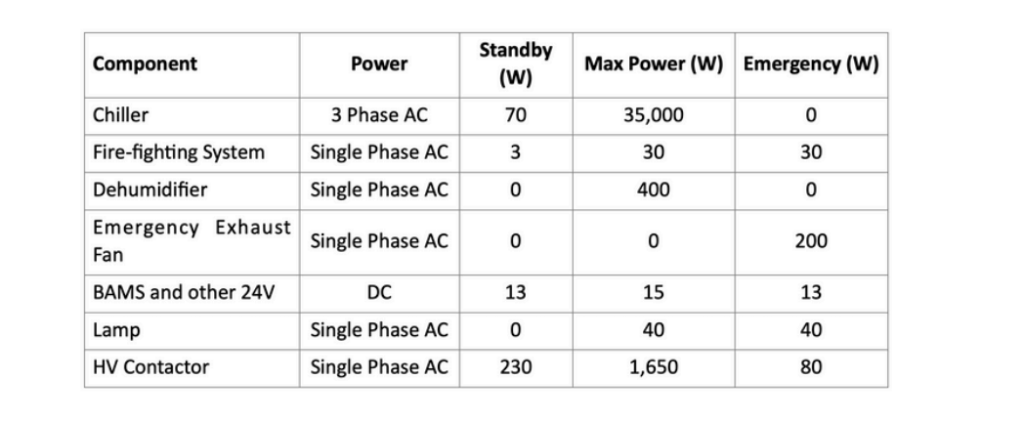
Total Power Demand:
- AC Load: 303W (standby), 37,120W (max), 350W (emergency)
- DC Load: 13W (standby), 15W (max), 13W (emergency)
- Combined Load: 316W (standby), 37,135W (max), 363W (emergency)
This data highlights the substantial operational energy footprint even in idle states. The data again varies from manufacturer to manufacturer, depending on their component selection and power requirement.
4. Capacity Augmentation Strategy
Instead of deploying a fully sized BESS at project inception, capacity augmentation is increasingly becoming a preferred approach:
- Definition: Incremental addition of BESS capacity over the project lifetime.
Advantages:
- Reduces upfront CAPEX.
- Aligns investment with revenue generation phases.
- Mitigates the impact of initial high degradation (especially in the first two years).
It is particularly effective in OPEX-sensitive models where financial agility is needed.
5. Design for Off-Grid BESS Projects
Unlike on-grid solutions that can draw auxiliary power from the grid, off-grid systems must be fully self-sustaining:
- Auxiliary Load: Must be accounted for from renewables or a backup diesel generator.
- System Sizing: Needs to accommodate battery degradation and ensure 24-hour coverage.
- Redundancy: Many off-grid designs incorporate diesel generators as fail-safe systems.
Battery energy storage capacity and renewables’ energy production capability goes down with time and thus, planning for off-grid solutions requires proper sizing planning and robust modelling.
6. Technology Selection Criteria
Choosing the right energy storage technology is pivotal to BESS project success. Factors include:
- Cost per kWh Stored: Not just upfront but over the life cycle.
- Round Trip Efficiency: Impacts long-term revenue.
- Footprint: Especially relevant for space-constrained installations.
- Charging/Discharging Compatibility: Must align with grid or load profiles.
- Maintenance Needs: Lower maintenance translates to lower OPEX.
- Component Availability: Ensures seamless replacements.
- Technology Maturity: Longer-established technologies offer more performance predictability.
- Market Adoption: More manufacturers mean competitive pricing and innovation support.
7. Financial and Regulatory Considerations
Financial Viability
A profitable BESS project depends on:
- Product Quality: Affects longevity and performance.
- ROI & Profitability Metrics: Informed by cost, performance, and revenue data.
- Reliability: Impacts O&M costs and uptime.
- Replacement Planning: Smooth transitions without project downtime.
Regulatory Compliance
Every project must align with:
- National and Local Policies
- Grid Standards and Safety Regulations
Non-compliance can derail project timelines, financial viability and sometimes lead to penalties.
8. Sustainability and End-of-Life Management
BESS sustainability isn’t limited to renewable integration. Long-term environmental impact and material recovery are vital:
- Recyclability of Components: From battery chemistry to metals and housing.
- Environmental Impact: From manufacturing through operation to disposal.
Responsible planning includes setting up end-of-life strategies, possibly in collaboration with recycling firms or battery repurposing initiatives.
Conclusion
BESS projects represent a confluence of technological innovation, strategic financial planning, and engineering precision. From nuanced CAPEX/OPEX management to efficiency loss modelling, every decision made during planning has downstream operational and financial implications.
This analytical exploration highlights that success in BESS implementation lies not in merely deploying battery systems but in doing so with foresight, data-backed design, and a clear understanding of the lifecycle dynamics. As renewable energy penetration deepens globally, well-executed BESS projects will serve as critical linchpins in creating a stable, sustainable, and decarbonised energy future.
Rahul founded Bollini Energy to assist in deep understanding of the characteristics of Lithium-ion cells to EV, BESS, BMS and battery data analytics companies across the globe. He can be reached at +91-7204957389 or bollinienergy@gmail.com.
Also read: Decode : Chapter 1 – Understanding BESS and its Applications
Subscribe to our Newsletter
Subscribe today for free and stay on top of latest developments in Cleantech domain.