From Solar to Supply Chains: Ghodawat Consumer Limited’s Roadmap to Sustainable FMCG Growth
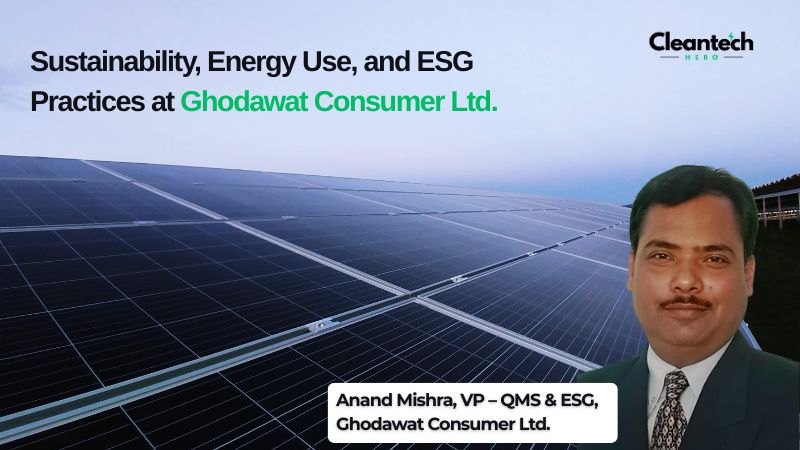
Anand Mishra, VP – QMS & ESG, Ghodawat Consumer Ltd., shares his perspective on the company’s sustainability journey in the FMCG sector. He discusses the internal and external drivers shaping GCL’s ESG strategy, the company’s progress in renewable energy adoption and operational efficiency, and the challenges of implementing sustainable practices within India’s complex supply chains. The conversation also highlights the growing influence of consumer expectations in accelerating responsible and transparent business operations.
1. What internal factors, like cost efficiencies or ESG commitments, alongside external drivers such as regulatory pressures and industry recognition, propel Ghodawat Consumer Limited’s (GCL) sustainability transition, and to what extent does evolving Indian consumer preferences rank among these influences?
At GCL, our sustainability journey is driven by a blend of strong internal commitments and external realities. Internally, ESG goals are now central to our business strategy, not just compliance metrics. We recognize that sustainable operations lead to long-term cost efficiencies, whether through energy savings, reduced waste, or supply chain optimization. Externally, evolving regulatory requirements and industry recognition, such as awards for procurement transformation, have accelerated our efforts. Importantly, today’s Indian consumers are highly aware and vocal about responsible brands; their demand for transparency and ethical practices is a major influence shaping our priorities. We view consumer expectations as a powerful force, on par with regulatory and economic drivers, in shaping our sustainability agenda.
2. What renewable energy sources such as solar or wind are currently deployed across GCL’s operations, and what proportion of your total energy requirement do they meet today?
GCL has systematically invested in renewable energy infrastructure, with solar being a major focus across our manufacturing sites. Currently, we have installed solar panels at our head office (100 kWp), rice plant (300 kWp), and beverage plant (250 kWp), with a combined installed capacity of 650 kWp. This investment has enabled GCL to achieve a renewable energy share of 37% of our total energy requirements to date. We have set an ambitious target to increase this share to 41% by the end of 2025, with an additional 950 kWp of solar panels planned for installation over the next two financial years (2025–2026 & 2026–2027).
GCL is also actively evaluating the adoption of wind energy to further diversify and strengthen our green energy portfolio. These ongoing and planned investments are part of our broader commitment to reducing GHG emissions and supporting global efforts to combat climate change.
3. What quantifiable progress has GCL made so far in terms of carbon emission reduction, water consumption reduction, and waste diversion from landfills?
We have made measurable gains across all sustainability pillars. Our operational efficiency initiatives have reduced the power usage ratio from 0.10 to 0.09 and the fuel usage ratio from 0.16 to 0.14, directly contributing to carbon emission reduction. On water, our beverage plant alone harvests 23,413 KL of rainwater annually, supporting our water neutrality target by 2030. In waste management, GCL has diverted [insert figure] MT of waste from landfills and achieved a zero waste-to-landfill rate of 58% to date. These outcomes reflect our data-driven, action-oriented approach to ESG.
4. From a business perspective, how is the shift to sustainability impacting costs and supply reliability?
While sustainable transitions may entail upfront investments, we are seeing tangible long-term benefits. Energy efficiency, local sourcing, and process optimization are driving down operational costs and enhancing supply chain resilience. Renewable energy adoption, for instance, has insulated us from some volatility in conventional power pricing. Moreover, robust sustainability practices are strengthening our brand and opening up new market opportunities, making the business case for ESG stronger each year.
5. Many FMCG companies struggle to scale renewable adoption beyond pilot projects. What is your take on this?
Scaling renewables in FMCG is challenging due to high baseline energy demands, legacy infrastructure, and the need for uninterrupted operations. At GCL, success has come from integrating sustainability into our core strategy and investing in both technology and people. A phased approach, starting with pilot projects, learning from them, and then scaling up through partnerships and targeted capital investments has helped us move beyond pilots to enterprise-wide adoption.
6. Are your renewable energy projects largely captive (on-site) or off-site, and what were the key challenges in integrating them into existing FMCG manufacturing operations?
Our current renewable energy projects are primarily captive, with on-site solar installations at our major production units. Integration into existing FMCG operations required careful planning to ensure consistent energy supply, manage load balancing, and upgrade legacy systems. Key challenges included optimizing plant layouts for solar deployment, aligning with regulatory norms, and training teams for new technologies. Collaboration with technology partners and a clear change management plan were instrumental for smooth integration.
7. In the Indian FMCG context, where fragmented supply chains and price sensitivity dominate, what sustainability challenges—such as rural reverse logistics, monsoon-driven waste, or informal recycling—pose greater hurdles as compared to other major economies?
India’s unique FMCG landscape presents distinct sustainability hurdles. Rural reverse logistics collecting and recycling packaging from dispersed locations is particularly complex. Seasonal factors like the monsoon exacerbate packaging waste and complicate waste management. Furthermore, a large share of informal recycling means ensuring traceability and compliance can be more challenging than in developed markets. These factors require innovative solutions, cross-sector collaboration, and government support to build scalable, transparent, and efficient systems.
8. What would be your one ask from the government that will help GCL in its sustainability efforts?
A supportive policy framework that accelerates the availability and affordability of high-quality recycled materials would be a game changer. Incentives for renewable energy adoption and streamlined regulatory approvals for sustainable technologies would further help FMCG players like GCL accelerate our climate and circularity goals.
Also Read: Battery Energy Storage in India: Geon’s Strategy, Localization, and Policy Outlook
Subscribe to our Newsletter
Subscribe today for free and stay on top of latest developments in Cleantech domain.