Inside YonderH2: Enabling Power Conversion for Green Hydrogen Projects
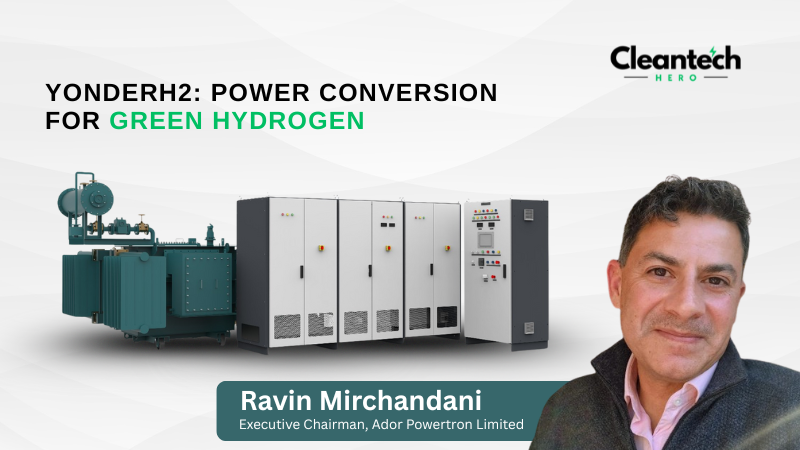
Ravin Mirchandani, Executive Chairman, Ador Powertron Limited, shares his take on the role of power conversion in enabling reliable, scalable green hydrogen production. By mapping YonderH2’s role in the production chain and discussing global bottlenecks, market dynamics, and project reliability, he explains where YonderH2 fits in the renewable-to-hydrogen value chain and how power quality directly shapes electrolyser performance. The article also explores how India-led manufacturing is supporting emerging hydrogen markets in Europe and beyond.
1- Where do YonderH2’s products sit in the green hydrogen production chain?
If you look at a green hydrogen plant end-to-end, YonderH2 sits exactly where electrons become molecules. On the left, you have the renewables – solar, wind, and hybrids. On the right, you have the electrolyser stacks, water treatment, compression, storage and end-use. We occupy the middle layer: we are the electrical backbone between the renewables and the electrolyser. Power Converters are 20% of the total cost of the electrolysers.
Our portfolio – converter transformers, thyristor and IGBT-based rectifiers – takes AC power from the renewable sources, conditions it, and delivers highly stable, tightly controlled DC that the electrolyser stacks need for efficient, long-life operation.
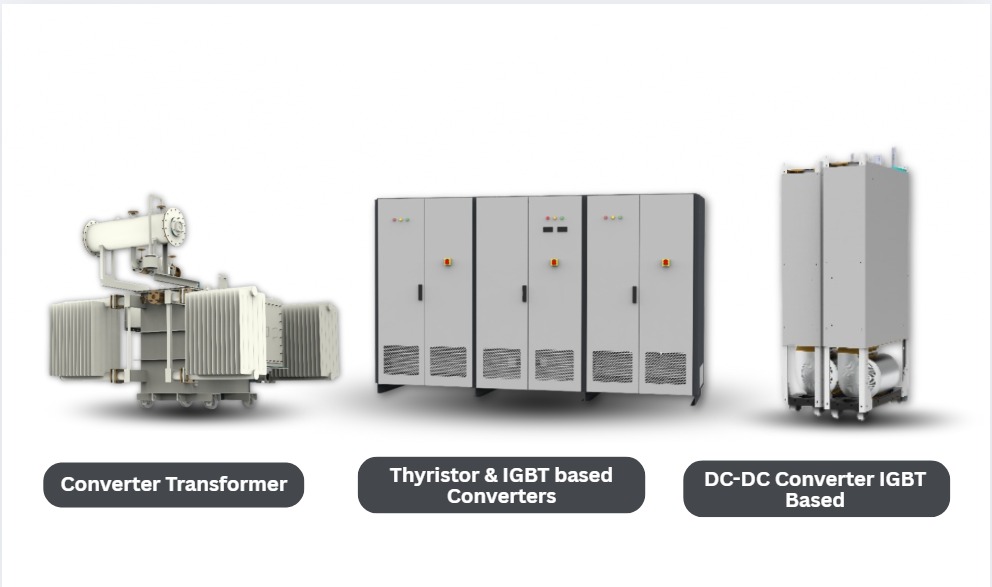
So, we don’t manufacture electrolysers or handle gas; we make sure every electron that reaches the stack is at the right voltage, current, and quality, 24/7. That’s the part of the value chain YonderH2 is dedicated to – being the most trusted DC power partner for green hydrogen projects globally.
2- Electrolysers are the “heart” of hydrogen production. What does “failure” look like if power conversion isn’t done right?
When power conversion isn’t done right, the electrolyser doesn’t just lose a bit of efficiency – the whole plant underperforms. Poor power quality – too much ripple, sudden spikes, slow reaction to changes – directly affects the core of the electrolyser, the cells where water is actually split into hydrogen and oxygen. That’s where you get extra heat, stress on materials and faster ageing. In real life, this means more unexpected shutdowns, more maintenance, and having to replace those core modules much earlier than planned.
From an investor’s or owner’s point of view, that’s what “failure” looks like: you’ve spent the capex, the plant is built, but it never quite delivers the green hydrogen output, reliability or lifetime that was in the original business case – and the cost per kilo which was calculated initially for the green hydrogen quietly moves in the wrong direction.
3- What are the biggest bottlenecks preventing faster commercialization of green hydrogen projects – and where does power conversion fit into solving these?
If you look at the market today, the bottlenecks are less about whether green hydrogen works and more about how fast we can make it bankable at scale. We are in what I like to call a “hydrogen winter” – a pause where a lot of announcements are being sorted into a smaller number of serious, financeable projects. The brakes today are quite clear: policy and incentive frameworks are still evolving, equipment costs and technologies (especially with very aggressive Chinese price curves) are moving targets, and boards are understandably cautious about long-term performance, uptime and offtake contracts before signing large cheques.
The positive side is that none of this is fatal – it’s exactly the kind of consolidation phase every new energy technology goes through. This is where disciplined engineering really matters, and that’s where power conversion comes in. If we can give developers and lenders high-efficiency, highly reliable DC power blocks that protect the electrolyser, follow renewables gracefully and behave predictably over 10-15 years, we take a big chunk of technical and economic uncertainty off the table. In other words, policy will catch up, costs will keep falling, but projects will move faster wherever the “plumbing” – including DC power – is robust enough that investors can trust the kilo-of-hydrogen that comes out of electrolysers will look like the one in their financial model.
4- You’ve positioned YonderH2 as focused “solely on DC power sources”. Can you walk us through the synergies with the overall technical competencies of the Ador Group?
When we say YonderH2 is “solely focused on DC power sources”, that doesn’t mean we’re a narrow company – it means we’ve taken the strongest part of Ador Powertron’s technical DNA and pointed it squarely at green hydrogen. Ador Powertron has spent three decades building some of the most demanding power-electronics systems in India – ESP transformer-rectifier sets for emission control, MW-scale DC supplies, EV fast chargers, battery formation and testing systems, military-grade UPS and power supplies. All of this is built on one common core tech stack: AC-DC conversion and grid interface, high-current rectification and DC-DC conversion, digital controls, thermal management, safety, and power-quality engineering.
YonderH2 sits on top of that same core stack and specialises it for electrolysers. The converter transformers, thyristor and IGBT rectifiers, and DC-DC converters we supply to hydrogen projects are direct descendants of Ador Powertron’s industrial power platform – just optimised for low ripple, tight voltage control and 24/7 hydrogen duty. The technology was literally born out of our long history in industrial power conversion and then refined into a globally deployable, field-proven solution for green hydrogen. So, the synergy is simple: YonderH2 keeps a sharp, exclusive focus on DC power for electrolysers; Ador provides the deep bench – R&D, IP pipeline, manufacturing scale, and multi-sector experience from hydrogen, EV charging and battery tech.
5- You mention “low ripple output” and “voltage stability” as critical features. Can you quantify what this means in practice-how much efficiency does a customer/ Electrolyser gain with your systems?
An electrolyser, at its core, is a very large electrochemical machine that wants one thing from its power supply: clean, steady DC current. When that DC becomes “noisy” – too much ripple, drifting voltage – two things happen. First, you waste energy: more of the input power is converted to heat inside the cells rather than hydrogen. Second, you shorten the life of the electrolyser, because you are effectively subjecting the cells to thousands of small stress cycles every day.
Independent studies on alkaline and PEM electrolysers show that high-ripple, loosely controlled power supplies can easily cost a couple of percentage points in efficiency at full load, and significantly more at part load, compared with a well-filtered, well-regulated DC source. That is exactly why we focus so much on low ripple and tight voltage control at YonderH2.
Our DC blocks are engineered to keep ripple typically below about 3% and to hold voltage in a very narrow, predictable band across the operating range. In practice, that means more of every megawatt you buy is actually splitting water, not heating hardware, and your electrolyser runs closer to its intended lifetime instead of being worn out early by poor power quality.
6- You have a 500 MW manufacturing facility in Pune. What’s your utilisation rate, and what would it take to justify expansion beyond this capacity?
As an organization we took a very deliberate decision to build ahead of the curve. The 500 MW facility in Pune was designed as a multi-year runway, not something we would fill in year one. Today, utilisation is healthy and steadily ramping, but we still have meaningful headroom by design – that’s what allows us to take on large, lumpy hydrogen orders in India and Europe without worrying about whether the factory can cope.
What would trigger expansion beyond 500 MW? Two things together: first, a visible multi-year order book (repeat programmes), not just one-off projects – that keep the existing lines busy on a sustained basis; and second, clearer policy support in key markets so that large hydrogen programmes don’t stop-start with every regulatory change. When those are in place, our next step is a brownfield expansion on the same campus: duplicate lines and more high-power test bays.
7- Can you walk us through the geographical footprint of your deployments?
In our home market, India, YonderH2 is embedded in almost every serious early green hydrogen initiative – from mobility pilots and refuelling stations to industrial projects and upcoming large-scale plants. That’s where a big part of our 60 MW-plus of installed DC power capacity sits today. This is also where we learned to engineer for tough grid conditions, high ambient temperatures, dust and very real-world uptime expectations.
In Europe, we’ve moved well beyond “pilot projects.” We have systems running in Germany, Denmark, Italy, Greece and Lithuania, working with electrolyser OEMs, EPCs and energy developers in what are arguably some of the most demanding power-quality and grid-code environments in the world. These aren’t one-off boxes we shipped and forgot about; they’re the start of long-term platform relationships where our DC power blocks are being standardised across multiple projects. So, our footprint today is India plus a growing European cluster – engineered and manufactured in India, made for the world – all running on the same YonderH2 technology platform and built out of our 500 MW facility in Pune.
8- India vs. Europe: Where do you see faster adoption over the next 3-5 years?
Actually, I don’t see this as a race, whether Europe is “ahead” or India is “catching up.” I see two very different types of leadership emerging over the next 3–5 years. In Europe, adoption will be driven by regulation and decarbonisation law. They have legally binding climate targets, industry-wide hydrogen quotas, and instruments such as the Hydrogen Bank and H2Global. That means a certain volume of projects has to happen, and we’re already seeing large industrial plants moving from PowerPoint to construction. It’s a very policy-led curve.
In India, the story is different – and in many ways more exciting. We have ultra-competitive renewable power (2nd-best pricing in the world after China), a national mission focused on green hydrogen, SECI auctions for both production and electrolyser manufacturing, and very ambitious private players who are thinking not just domestically, but also for export to Europe and Asia. From a small installed base, that can translate into very rapid adoption once the first few large projects are online. We already see that on the ground – YonderH2 is powering most of the first serious projects in the country, and to the best of our knowledge, we’re still the only Indian company to have crossed 60 MW of DC power sources supplied to green hydrogen plants.
So, my answer is: Europe and India will both adopt fast, but in different ways. Europe will be regulation-led, India will be cost-led and export-led, and European tech with Indian manufacturing would be an ideal situation to counter the most competitive Chinese pricing. As YonderH2, engineered and manufactured in India and field-proven in Europe, we’re deliberately positioned so that whichever curve bends up faster, the DC power backbone is ready – with a very strong bias in our hearts toward making India a serious global hydrogen player.
Also Read: India’s Green Hydrogen Aspirations | Sachin Chugh, ARUP
Subscribe to our Newsletter
Subscribe today for free and stay on top of latest developments in Cleantech domain.