Turning Forest Waste into Biochar: Building a Clean Energy Business
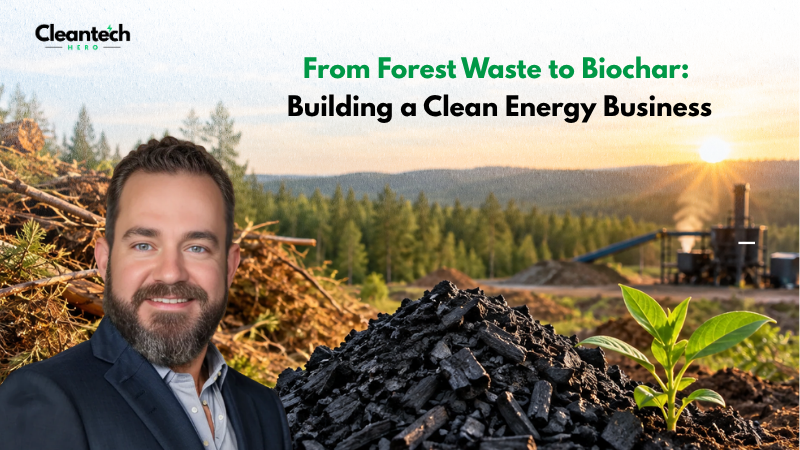
This interview with Justin, CEO of Dakota Biochar, explores how forest waste can be converted into biochar, renewable power, and carbon credits. The discussion covers biochar’s applications in agriculture, livestock and oil-field cleanup, its role in reducing fertilizer costs and improving soil, the use of pyrolysis for on-site power generation, carbon-credit revenue, and the business model behind decentralized biochar facilities. McNeil also discusses the challenges of operating in forests, Dakota Biochar’s plans to expand across the United States, its approach to government support, and advice for startups entering the biochar sector.
1. You’ve described biochar as a way of turning waste into a valuable product. What exactly is biochar, and how is it produced?
Biochar has existed since the beginning of time. Human beings have always burned biomass, and the ash and carbon left over from that process are essentially what we call biochar. The key difference is that biochar is produced by heating biomass without oxygen.
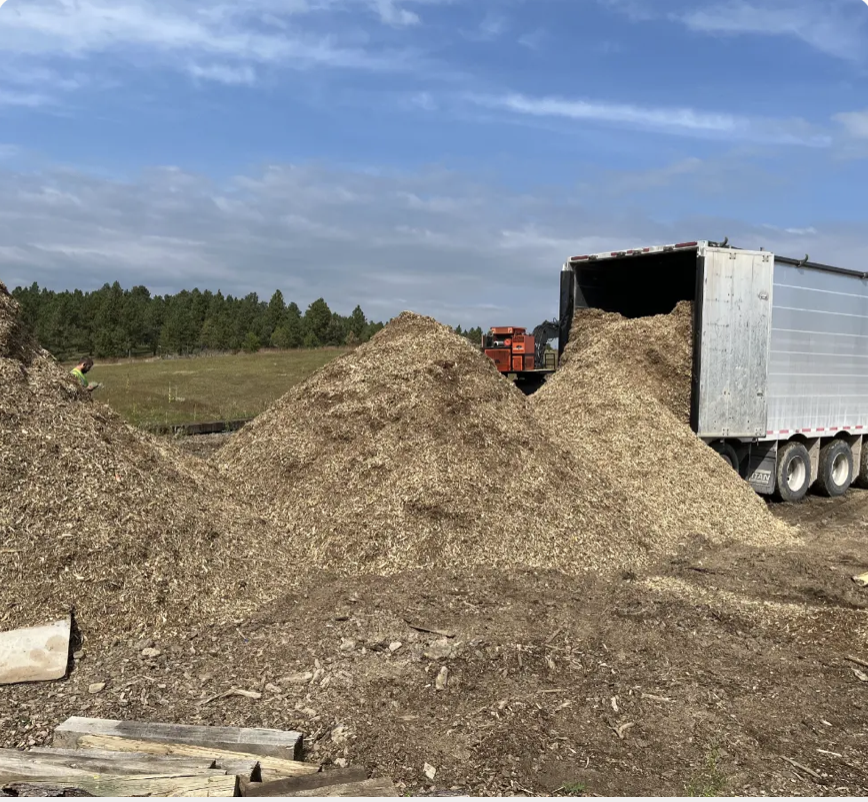
Normally, when you burn something, oxygen enters the system and combustion turns much of the material into smoke or ash. With pyrolysis, biomass is heated without oxygen. It is essentially cooked down into a charcoal-like material called biochar.
I saw a huge waste stream here in South Dakota and started addressing it. Now we are looking at waste streams across the country and installing technology to upcycle that waste into a valuable product while also generating renewable power.
2. What are the primary applications for the biochar you produce?
Historically, biochar has been used for water and air filtration. In South Dakota, agriculture is the biggest industry, so that was the market I wanted to address.
We use biochar for soil remediation and soil improvement. We are also using it as an animal-feed supplement. Because biochar acts like a sponge, it can absorb unwanted substances in an animal’s digestive system. Livestock producers are seeing higher nutrient uptake from feed while using less feed, which can help offset the cost of the biochar.
In Texas, we also use biochar for oil-field cleanup. In the event of an oil spill, the biochar can be used to absorb the material.
3. Can biochar replace fertilizer, or does it reduce the amount of fertilizer farmers need over time?
Our proposition to farmers is that biochar can help decrease their input costs. Biochar can remain in the ground for more than 100 years.
We activate our biochar based on what the farmer is trying to grow. If they are growing corn or soybeans, for example, they would normally use nitrogen, phosphorus and potassium. Instead of simply spraying those nutrients onto the crop or soil, we can put them into the biochar and then incorporate the biochar into the ground.
The biochar binds those nutrients and retains them in the soil until the plant needs them. As the fertilizer is depleted, the farmer can add more, and the biochar can continue to retain it.
In South Dakota, farmers may spend roughly $150 per acre on fertilizer, and with our product we are seeing that cost reduced to around $100 per acre.
4. You also generate electricity through the biochar process. How does that work?
The pyrolysis process generates a significant amount of heat. We capture that heat and send it through a heat recovery steam generator, which produces steam.
The steam turns a turbine, the turbine turns a shaft, and the shaft turns a generator to produce electricity.
We generally use that electricity for on-site needs rather than selling it to utilities. Depending on the size and scale of the facility, our biochar reactors generate less than 10 MW of power. That is not enough to operate as a conventional utility-scale power generator, but it can power our equipment, an on-site microgrid, or a farmer’s equipment.
The idea is to create greater resilience by generating power closer to where it is needed rather than transmitting electricity over long distances.
5. How does your feedstock collection model work with timber companies and other sources of forest residue?
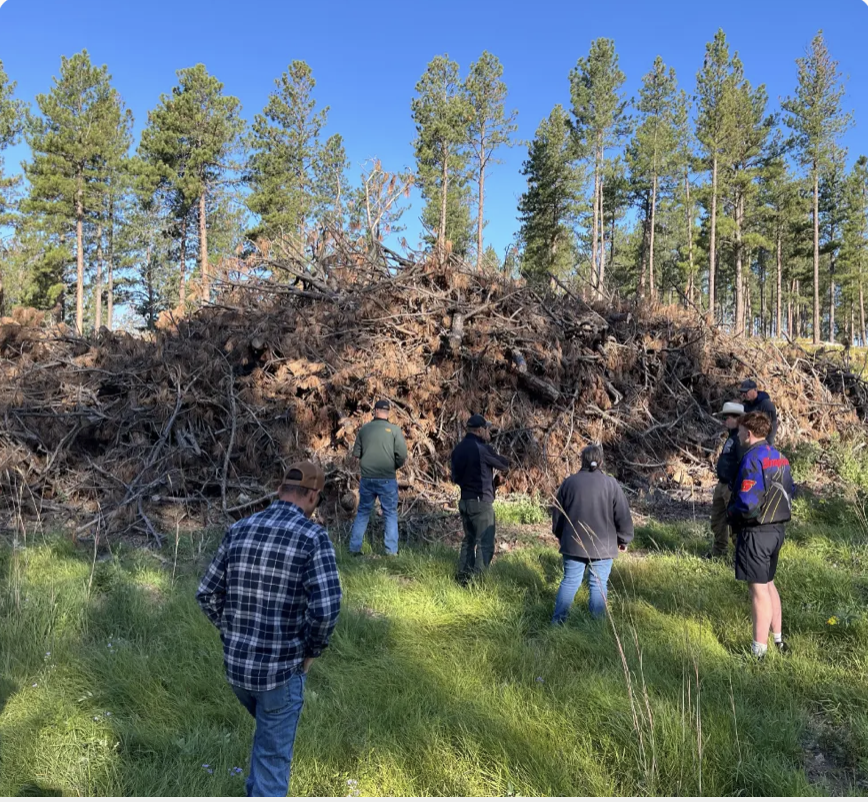
We have a crew that goes out and collects material because we are currently at a scale where we need to continuously feed the reactors.
We also have a drop-off site where people can bring material, and we charge a certain price per ton to receive it. We then process the feedstock into a size suitable for our reactors.
For larger sites, such as a 100-acre area that needs to be cleaned up or thinned, we use large equipment capable of processing hundreds of acres of land in roughly a week.
6. How do you calculate the carbon emissions avoided through the production of biochar, and how do carbon credits fit into the business?
We generate carbon credits, or carbon-offset reduction credits, but there is a detailed auditing process involved.
Auditors look at the type of feedstock being processed and what would happen to it if it were simply left to decay. They then conduct what is called a lifecycle assessment, looking at the emissions associated with our process and subtracting those from the baseline emissions.
For example, if one ton of material would produce four tons of CO₂ if left to decay, and our process results in a net reduction of 2.5 tons, the calculation would result in 2.5 carbon credits per ton of material processed.
Those credits can then be sold at the prevailing market rate.
7. Who typically buys the carbon credits you generate?
A number of countries have introduced policies requiring companies to offset their emissions, although the United States does not have a carbon exchange in the same way.
European energy producers, for example, have requirements related to offsetting carbon emissions. Companies such as Microsoft and United Airlines have also stated that they want to reduce or offset their carbon emissions.
These companies can purchase credits from businesses like Dakota Biochar that are sequestering or offsetting carbon emissions.
8. What are the different revenue streams in your business model?
We have four main revenue streams.
First, we receive a tipping fee for collecting or receiving waste material.
Second is the sale of biochar, which we have developed into several different markets.
Third is carbon-credit revenue from selling the carbon credits generated through our process.
Fourth is power-generation revenue. We provide electricity to customers with on-site power requirements.
There can also be an additional opportunity from waste heat. For example, at a sawmill, we could provide heat for drying incoming wood. Cement and asphalt plants also have significant heat requirements, so excess heat can become another revenue stream.
9. Which of these revenue streams is currently the largest for Dakota Biochar?
Currently, biochar sales are our largest revenue generator.
Part of that is because we have priced the product appropriately and built a market for it. There are many people giving biochar away for free, but a lot of producers do not test their biochar, so they do not necessarily know what they are producing.
We provide a certificate of analysis with every lot. We look at three major characteristics: ash content, volatile matter, and fixed carbon.
We aim for very high fixed carbon—around 90%—with low ash and volatile matter. High ash can indicate oxygen entering the system, while high volatile matter can indicate that the material has not been heated for long enough.
10. What energy source do you use to generate the heat required for pyrolysis?
We initially start the reaction by burning wood, which provides the initial heat source.
As the wood heats the reactor, the incoming feedstock begins to release what is called synthesis gas, or syngas. We recycle that syngas back into the system and combust it to create additional heat.
So the process works as a circular-loop system, where the syngas produced during the process becomes part of the heat source.
11. Your business combines soil improvement, wildfire prevention, carbon removal, electricity generation and multiple revenue streams. What are the potential downsides?
One major concern is starting a fire. We operate in forests, where conditions can be very dry. When we grind large piles of material, a piece of metal passing through the grinder could create a spark.
We are very conscious of that risk. I own the largest fire truck in the state to help combat potential fires.
Another issue is that biochar can be applied incorrectly. The worst thing it can do in the ground is nothing. If you apply biochar to an application where it does not belong, it may provide no benefit.
That is why we have spent significant resources making sure our product is appropriate for the applications we target.
12. How important is the quality and production process of biochar to its effectiveness?
It is extremely important. Not all biochar is made the same.
Producers need to understand their process, how they are making the biochar, and how they can control the production conditions.
For buyers, I would recommend asking for a certificate of analysis, understanding how the biochar was produced, and making sure the producer can demonstrate that the product will deliver the results they claim.
13. What is your long-term vision for Dakota Biochar? Do you plan to expand beyond South Dakota?
I want to take Dakota Biochar across the country.
We have identified 10 sites across the United States where we plan to build facilities. We are not trying to become a manufacturer of biochar equipment. Instead, we want to solve the waste-stream problem wherever it exists.
We started in South Dakota, and our next 10 sites are spread across the country. I have also set a goal of building 50 sites within the next three years.
14. What kind of partnerships are you looking for to support that expansion?
I am looking for joint-venture partners who have access to land and feedstock.
We bring the technology, systems, markets for the biochar, carbon-credit revenue opportunities, and the business model for operating the facility. The local partner would provide access to the resources and site needed for the operation.
15. You ran for the U.S. Senate earlier this year and campaigned on fiscal responsibility and reducing government overreach. Now, as a business owner yourself, how does Dakota Biochar reconcile that position with its reliance, or lack thereof, on government support such as carbon-credit policies, renewable-energy incentives and grants?
I stand tall on that. We have not received any government assistance in our process. Our business case works without government support, and we are providing a service to the Forest Service without costing the government money.
That does not mean we have never applied for grants. We have applied for grants, but we have not received any of them. A grant is also different from a subsidy, and we do not have government tax credits or similar support.
From my perspective, the grant process can allow a private business to address a problem at a lower cost than it might otherwise cost the government directly.
16. What is the one mistake you would advise startups entering the biochar business in India to avoid? Have your technology figured out and start small.
I started with a market demonstration unit. At our first site, we processed around 8,000 tons of material a year. It was not a huge amount, but it was enough to get started and learn.
The capital expenditure was much lower at that demonstration scale, and we learned a lot by operating the reactors and understanding the technology. Eventually, we found that the technology we needed did not exist in the marketplace, so we had to engineer and build what was required for our specific application.
I would recommend the same approach in India: start on a smaller scale, identify the problems and technical challenges, prove the concept, and then scale up.
You could spend $100 million trying to solve a problem, but I would rather solve the $1 million problem first and then scale that solution once it works.
A lot of large projects spend huge amounts of money before discovering that the technology does not work as expected. So I would say: start small, prove the concept, and then scale up.
Also Read: Beyond Electrolysis: Bringing Biomass into India’s Hydrogen Future
Subscribe to our Newsletter
Subscribe today for free and stay on top of latest developments in Cleantech domain.