India Advances Carbon Capture, Utilisation and Storage Initiatives Across Industrial Sectors
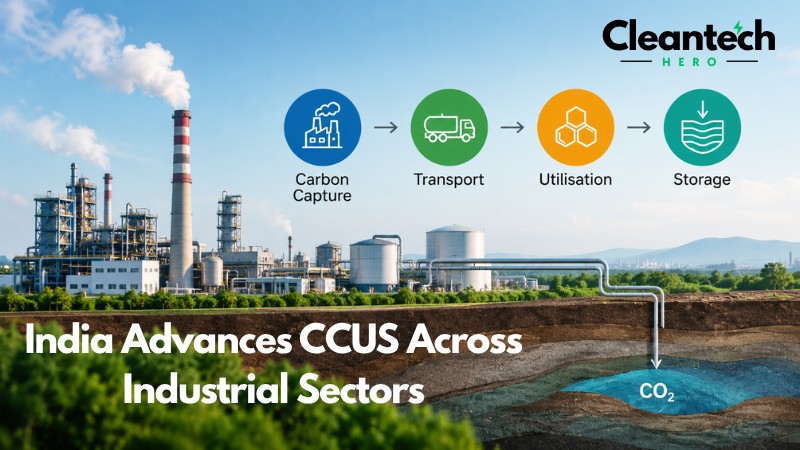
India is advancing Carbon Capture, Utilisation and Storage (CCUS) initiatives to reduce carbon dioxide emissions from hard-to-abate sectors, including power, steel, cement, refineries and chemicals. The initiatives cover research and development, pilot projects, technology deployment and policy support as part of the country’s efforts to achieve Net Zero emissions by 2070.
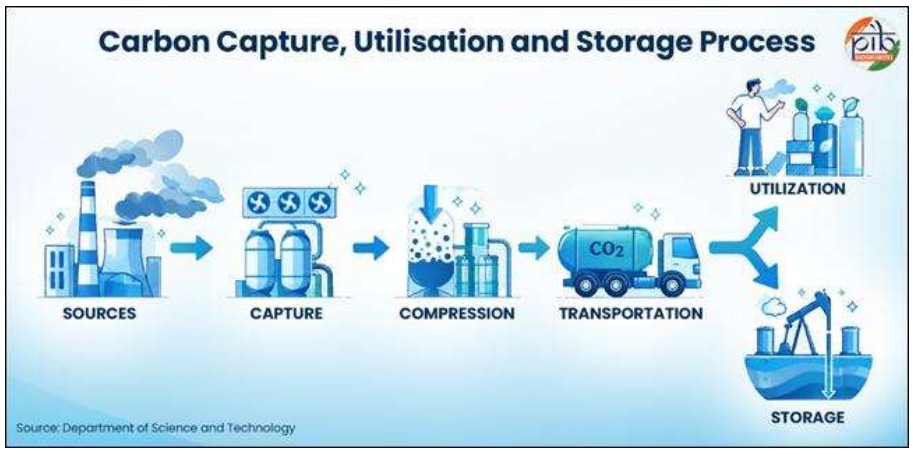
CCUS involves capturing carbon dioxide from industrial processes and either using it in other applications or storing it in geological formations. The technology can help address emissions from industries where electrification and renewable energy alone may not eliminate all emissions.
Government Funding and Policy Initiatives
The Union Budget 2026–27 allocated ₹20,000 crore over five years for CCUS development across five sectors: power, steel, cement, refineries and chemicals.
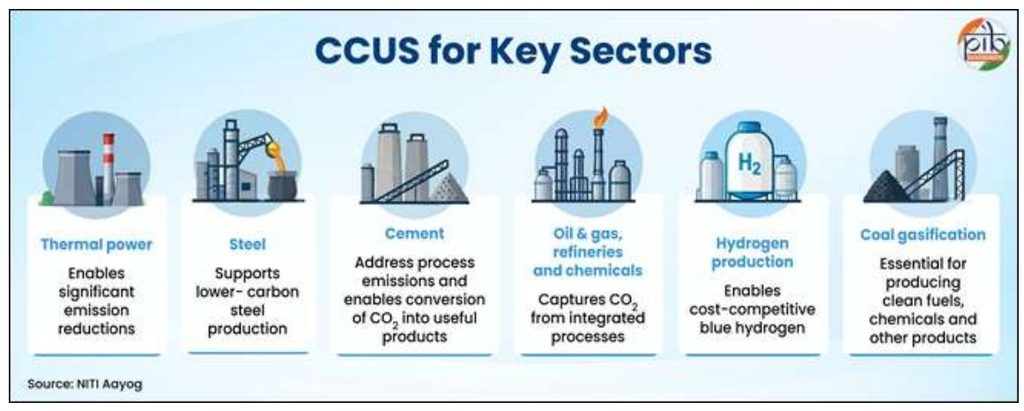
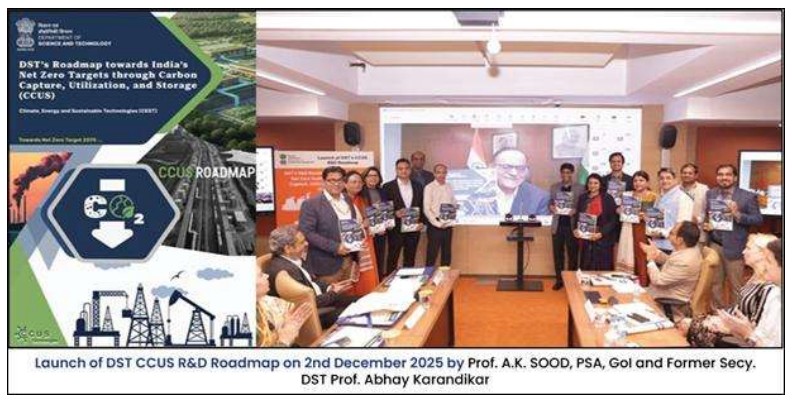
The Department of Science and Technology (DST) released its CCUS Research and Development Roadmap in December 2025 to guide research, technology development and deployment. NITI Aayog’s 2022 report on CCUS outlined policy measures for deploying the technology in hard-to-abate sectors.
The government has also supported CCUS research through national centres and international collaborations. The DST and Department of Biotechnology (DBT) have participated in research initiatives under Mission Innovation and other international platforms.
CCUS Research and Demonstration Projects
India’s CCUS programme includes pilot facilities focused on carbon capture, utilisation and storage.
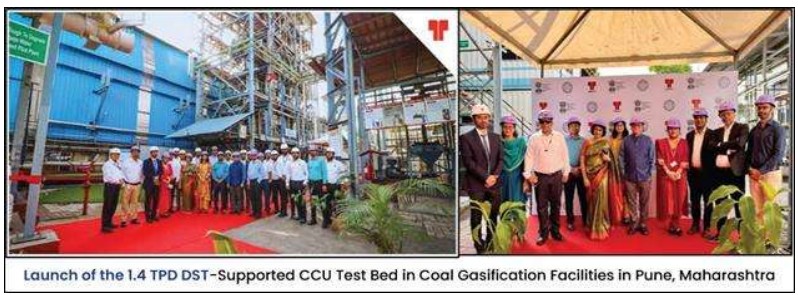
- Coal gasification: DST has supported two technology deployment testbeds involving IIT Delhi and Thermax, and CSIR-IICT Hyderabad and BHEL. The projects aim to demonstrate methanol and dimethyl ether (DME) production using captured carbon dioxide in coal-gasification facilities.
- Cement sector: In May 2025, India launched a cluster of five Carbon Capture and Utilisation (CCU) testbeds involving cement companies and research institutions. The projects cover carbon capture, mineralisation and the conversion of captured carbon dioxide into concrete products.
- Integrated CCUS facility: An integrated CCUS field laboratory at IIT Bombay was inaugurated in May 2026. The facility can capture up to three tonnes of carbon dioxide per day from industrial emissions and ambient air using non-potable water and convert it into carbonate and bicarbonate products. Research also includes assessing carbon dioxide storage potential in Deccan Traps basalt formations.
Potential Applications of Captured Carbon Dioxide
Captured carbon dioxide can be used in the production of chemicals, fuels, building materials and other products. Applications include concrete and aggregates, synthetic fuels, methanol, polymers and algae-based products.
CCUS can also be integrated with hydrogen production. Carbon capture may be used alongside hydrogen production from fossil fuels or coal gasification to manage associated carbon dioxide emissions. The emissions reduction achieved depends on the capture process, energy requirements and management of residual emissions.
Captured carbon dioxide can be permanently stored in deep underground geological formations, including depleted oil and gas reservoirs, deep saline aquifers and basaltic rock formations, as outlined in NITI Aayog’s CCUS policy report.
Industrial Clusters and Project Pipeline
Regional CCUS hubs and clusters can connect industrial emitters with shared carbon dioxide transport, utilisation and storage infrastructure. Potential regions include Gujarat’s industrial belt, the Odisha–Jharkhand industrial region and parts of Northeast India.
As of April 2026, India had three operational CCU projects (with one each in Madhya Pradesh, Tamil Nadu and Maharashtra), six projects under construction or execution (Andhra Pradesh with three projects, Telangana with two and Maharashtra with one), and 16 proposed projects across several states (Assam and Odisha with four projects each, Gujarat and Rajasthan with two each, Andhra Pradesh, Madhya Pradesh, Haryana and Tamil Nadu have one project each). These projects involve public sector enterprises, private industry and research institutions at different stages of development.
The DST and Department of Biotechnology have also supported CCUS research under Mission Innovation, including projects focused on carbon capture, storage and utilisation technologies.
Outlook
India’s CCUS initiatives span policy development, research, pilot-scale demonstrations and proposed industrial projects. Their contribution to emissions reduction will depend on technology performance, project economics, the availability of transport and storage infrastructure, and the ability to scale beyond pilot facilities.
CCUS is being pursued as one of several approaches to reducing industrial emissions as India works towards its Net Zero target for 2070.
Read the full backgrounder published by the Press Information Bureau (PIB) here.
Also read: Carbon Capture, Utilisation and Storage: A Crucial Bridge to Net-Zero for India and the World
Subscribe to our Newsletter
Subscribe today for free and stay on top of latest developments in Cleantech domain.