Beyond the Tagline: Decoding the Greenwashing Debate in Clean Energy & Storage
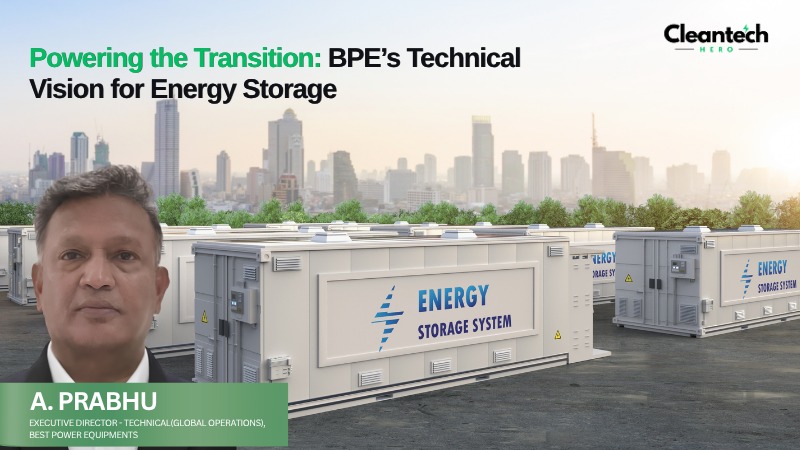
This interview of A. Prabhu, Executive Director – Technical (Global Operations) at Best Power Equipments (BPE),examines the practical realities and engineering challenges of the clean energy transition in the backup power and storage sectors. It addresses how to distinguish true technical readiness from surface-level greenwashing, compares the true lifecycle and economic value of lithium-ion versus lead-acid systems, and provides a candid perspective on the actual progress of domestic cell manufacturing and market drivers shaping the future of sustainable infrastructure.
Q1. How would you define “greenwashing” in the context of the backup power and energy storage industry specifically? What does it look like when a company does it?
A. Greenwashing in backup power and storage means marketing devices as “clean” or “green” while ignoring their real footprint, making sustainability claims backed by limited data. It shows up as sustainability reports built on partial information, inflated efficiency ratings, and vague recycling plans. At BPE, credibility means backing every claim with transparent, robust processes, from specification through to result.
Q2. Lead-acid still dominates India’s backup power market largely on cost grounds. As an engineer who has tracked this space for decades, how much of that is genuine technological and infrastructural lag, and how much is simply that the market hasn’t yet demanded the shift?
A. Under RoHS declarations, corporates are increasingly reviewing the use of lead-acid batteries and their end-of-life disposal. Key devices such as mobile phones, computers, laptops, tablets, and many medical monitoring instruments have already moved away from lead-acid batteries under competitive pressure. The power-backup market is gradually reducing the space it allows for lead-acid batteries, too, and that shift is likely to accelerate until very little room remains for them.
RoHS (Restriction of Hazardous Substances) restricts the use of specific hazardous substances in electrical and electronic equipment sold in the European Union to protect environmental and public health.
Q3. What, in your assessment, separates a power-solutions company that is “renewable-ready” in messaging from one that is renewable-ready in actual engineering and supply chain?
A. The difference shows up in the details, not the tagline. A company that is renewable-ready in messaging talks about solar and battery integration in its brochures but sells hardware built around grid or diesel assumptions. One that is renewable-ready in engineering designs for variable input, bidirectional inverters, and battery chemistries that handle deep cycling, and backs it with suppliers vetted for sourcing and capacity. At BPE, we test that readiness against real solar and off-grid conditions, not just against spec sheets.
Q4. From your engineering background, what is the real-world performance and lifecycle gap between lithium-ion and lead-acid systems, and does that gap justify the premium pricing that is often used to position lithium-ion as the “sustainable” choice?
A. From an engineering perspective, the gap between lithium-ion and lead-acid batteries is quite significant. A lead-acid battery typically takes around 8–10 hours to charge, whereas a lithium-ion battery can be charged in as little as 30 minutes to a few hours, depending on the application. In fact, the EV revolution would not have been possible without lithium-ion technology.
Yes, lithium-ion batteries cost around 1.3 times more upfront, but they also deliver much higher value. They offer up to 95% usable capacity, compared to around 60% for lead-acid batteries, and last 10–12 years instead of just 2–3 years.
From a sustainability standpoint, lithium-ion also has a clear advantage. It avoids the challenges associated with hazardous lead disposal, requires far fewer replacements over its lifetime, and is over 20% more energy efficient. So, if you look beyond the initial purchase price and consider performance, lifecycle, and environmental impact, lithium-ion is not really a premium choice; it is the more sustainable and economical one in the long run.
Q5. To what extent is the “Made-in-India clean energy” claim realistic for Indian industry today, given persistent cost sensitivity in corporate procurement and the nascent state of domestic lithium-ion cell manufacturing? What would substantive, genuine domestic capability actually require in terms of manufacturing depth, supply chain maturity, and policy support?
A: “Made-in-India clean energy” is still more ambition than reality. Under the Advanced Chemistry Cell Production Linked Incentive (ACC PLI), India targeted 50 GWh of lithium cell-manufacturing capacity, but only about 3% of that (roughly 1.4 GWh) had been commissioned within the timeline, with land acquisition largely complete for the rest. Commercial cell production from most beneficiaries is likely to come on stream only over the next year or two. In the meantime, cost-sensitive buyers continue to favour cheaper imported cells while domestic capacity catches up.
Real domestic capability would need three things: deep manufacturing know-how, meaning not just battery-pack assembly but actual cell production at scale; a mature supply chain for critical minerals and cell components; and sustained policy support, including tariffs and a dedicated critical-minerals scheme to protect and enable local manufacturers while they scale.
At BPE, we stay upfront about this. We use Indian-made components where they are genuinely ready, and we don’t label something “Made-in-India” just because it is assembled here.
Q6. Enterprise clients across BFSI, telecom and data centres are under growing ESG pressure from regulators and investors. How much of that is translating into genuine demand-side push for verified sustainable power solutions by companies operating in these industries?
A: It is definitely on the cards. The real focus now is on implementing it at scale, and CapEx allocation will be the prime driver.
Q7. Which industries are expected to be the biggest demand drivers of “green power” over the next decade?
A: Commercial and industrial (C&I) users are expected to be the biggest demand drivers, for several good reasons: reducing polluting components, optimising resources, conserving energy, cutting carbon, and meeting CSR commitments, all pointing toward a trillion-dollar market. Backup power will also support highways as a fuelling source for electric vehicles and serve as a source of energy in isolated and disaster-recovery situations.
Q8. Where do you see the backup power industry in five years on this question: closer to genuine lithium-ion and renewable-first solutions becoming the norm, or still managing the gap between sustainability marketing and ground reality?
A: Five years out, I’d bet we’re closer to lithium-ion and renewable-first becoming standard for new installations, not just a marketing layer. Battery costs keep dropping, and supply chains are maturing fast enough that “green by default” starts to make commercial sense, not only PR sense. But the gap won’t fully close: diesel-heavy legacy fleets stick around, and some companies will still dress up old tech in new language. At BPE, we’re not waiting for the industry to catch up; we’re building toward that lithium-first standard now.
Q9. What is BPE’s current roadmap for transitioning legacy product lines, particularly UPS and storage batteries, fully toward lithium-ion?
A: BPE is guided by the principle of adopting newer technology quickly and putting it into delivery. Currently, the majority of our installations use lithium batteries, unless a customer specifically asks for lead-acid batteries.
Also Read: Enabling climate-focused startups | Interview with Dinesh Pai from Rainmatter
Subscribe to our Newsletter
Subscribe today for free and stay on top of latest developments in Cleantech domain.