Nichicon on LTO Batteries, IoT and the Future of Energy Storage

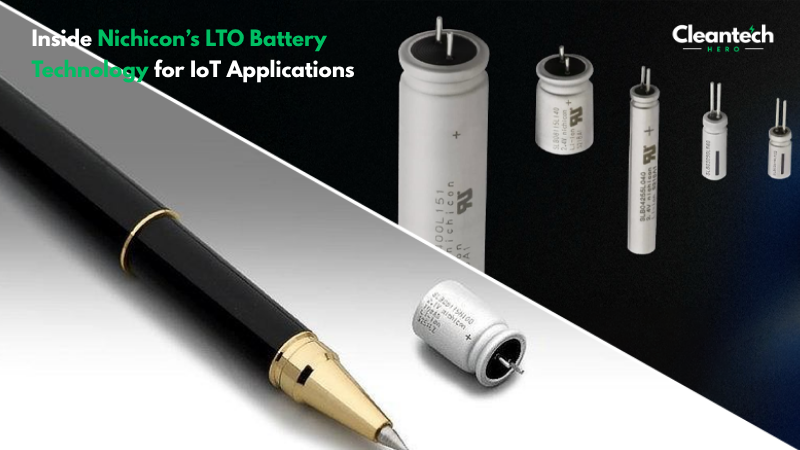
This interview with Klas Engstrom explores Nichicon’s LTO battery technology, its position between supercapacitors and lithium-ion batteries, and its applications in compact IoT devices. Engstrom also discusses the technology’s use in the smartphone stylus, energy harvesting, frequent-recharge applications, battery life extension, and the potential for LTO batteries in India.
1. Nichicon has a 75-year history rooted almost entirely in capacitor manufacturing, dating back to 1950. The SLB battery series, launched in 2019, marked a significant departure into an entirely new product category. What led the company to make that shift after so many decades in one line of business?
We have a very long history in capacitors, particularly aluminum capacitors, but Nichicon has also been working with supercapacitors for more than 30 years.
What we developed starting in 2019 was a rechargeable battery that could fill the gap between supercapacitors and lithium-ion batteries. With the growing number of IoT devices and the prospect of billions of devices being deployed, we saw this as an area of high importance.
It also connects closely with our mission of focusing on sustainability and green technology. We saw an opportunity to provide an energy-storage solution that could support the growing IoT ecosystem.
2. Most lithium-ion battery types take their name from the cathode material — LFP, NMC and LCO, for instance — while the anode is typically some form of graphite or carbon. LTO batteries are the exception, named after the anode instead, since the graphite anode is replaced with lithium titanate oxide. Could you explain the reasoning behind that substitution and what advantages this combination delivers?
Our batteries are called LTO batteries, which stands for lithium titanate oxide. While the technology sounds similar to lithium-ion batteries, the technology is significantly different because of the electrode configuration.
This makes our batteries extremely low-resistance and very powerful, particularly at low temperatures. They are also capable of handling extremely high power and very high currents.
Another important advantage is safety. You can puncture these batteries, cut through them or even expose them to a torch without the risk of fire or explosion associated with conventional lithium-ion batteries.
3. Much of the industry is focused on maximizing energy density – building smaller, more powerful batteries. Your battery takes the opposite approach, trading off energy density for other benefits. In which applications does that trade-off make your battery the clear choice, and when would you steer a customer toward a standard lithium-ion battery instead?
It is true that our batteries have substantially lower energy capacity than lithium-ion batteries, but that is also where we want to be positioned. We are targeting the gap between supercapacitors and lithium-ion batteries.
Our key advantage is extremely high power density. We have identified three main application areas.
The first is applications powered by energy harvesting. If an application is continuously harvesting energy from sources such as light, the amount of energy stored in the battery becomes less important because it can be replenished regularly. What is important is having sufficient power density to provide the required burst current when needed.
The second is applications that can be recharged very frequently. A restaurant pager is one example. It can go to a table, use some energy, return to the counter and then be fully charged before going out again. In such an application, high energy capacity is not necessarily required.
A dentist’s tool is another example. If the battery can run through one patient and then be fully charged within one or two minutes while waiting for the next patient, a large energy capacity is not necessary.
The third application is using our battery together with a larger primary battery. The primary battery provides the main energy storage, while energy is transferred to the LTO cell. When high current consumption is required, that current can be supplied by the LTO battery. This makes things easier for the primary battery and can extend its life, providing a better overall solution for the customer.
4. Your battery has been used in Samsung’s Galaxy Note10 S Pen since 2019. What did the Nichicon LTO battery enable Samsung to achieve in the S Pen?
I actually have the pen and phone here, and I still use them today.
Before our solution, the pen could not communicate with the phone. What we made possible with the LTO battery was to place a very small energy-storage device inside the pen that was still powerful enough to support the burst current required for Bluetooth Low Energy (BLE) communication.
So the key was high power density in a very small volume, allowing the pen to support the burst current needed for IoT-type communication with the phone.
5. Before your battery came along, the industry essentially had two options – a battery discarded once it dies, or one recharged a limited number of times before it eventually needs replacing. Would it be fair to say your battery is designed to eliminate both of those failure modes at once?
Yes. The idea is to provide a battery that can support applications over a much longer period and reduce the need for unnecessary battery replacement.
Supercapacitors have been available for more than 30 years and can serve a similar purpose, but our LTO batteries provide substantially higher energy density. We can store perhaps eight times more energy than a supercapacitor, which allows the technology to be used in many more applications.
6. Let’s put that into a real scenario, say a deployment of 10,000 field sensors. What’s the actual operational difference between replacing batteries every two to three years versus not touching them for 15 years? If you can put a number on it; trucks not sent out, technicians not dispatched, batteries not manufactured- even using rough assumptions would help.
We imagine a future of having not 10,000 but billions and trillions of devices in the field, and even with an example involving 10,000 units, it doesn’t make mathematical sense having to ever replace those batteries.
The cost of replacing a battery once would be higher than the price Nichicon would charge for one LTO cell. The challenge is that the person making the decision about the initial investment is not necessarily the person responsible for the lifetime operating costs in the field.
So while the mathematics are quite clear, the decision-making structure within companies can make it more difficult to adopt this approach.
7. Your SLB series is built on Toshiba’s SCiB technology rather than something developed independently. What exactly does Nichicon contribute in that relationship, and what stops a customer from approaching Toshiba directly instead?
We use intellectual property rights from Toshiba and purchase our electrode material from Toshiba. We believe this is a very good setup because Toshiba has extensive capabilities in battery technology.
There is a clear division between the two companies. Nichicon serves the very small form-factor market, while Toshiba does not approach that market. Conversely, Toshiba serves larger form factors, such as battery blocks for trucks and buses, while Nichicon does not address that market.
Our experience in aluminum capacitors is particularly relevant to the smaller form factors. If you look at our LTO batteries, they resemble capacitors, and we benefit from our decades of experience manufacturing round, cylindrical, wound-foil products.
8. Nichicon runs a campaign called #Nomorebatteries, which is a bold statement for a battery company. How does the company make up for the recurring revenue that would normally come from replacement batteries, and how receptive have customers been to paying more initially?
It is a challenge because one person is often paying the initial bill, while another person is responsible for the lifetime cost in the field.
From Nichicon’s perspective, however, we have not been part of the battery market for a very long time. We entered this market in 2019, and we may have already sold more than 100 million batteries.
For us, every newly sold battery represents additional business. We are happy to contribute to a more sustainable future where electronics can remain in use without being unnecessarily discarded and replaced many times.
9. Looking at the broader lithium battery market, across consumer electronics, industrial logistics and shipping, energy storage systems, electric vehicles, retail and security – what share does LTO technology currently hold overall, what portion does Nichicon capture, and where do you see that standing by 2030?
We have delivered more than 100 million of our batteries to the market, but we are still at the very beginning of our business activities, so it is relatively difficult to forecast exactly where we will be by 2030.
However, we expect substantial changes. While we have so far sold 100 million batteries, if everything goes well, we could potentially reach a level of 100 million batteries per month in the far future.
10. Asset tracking, smart pallets, wireless sensors and RFID form the backbone of modern supply chains. As India rapidly builds out its logistics and IoT infrastructure, where do you see the earliest real demand emerging? And separately, how significant is India as a market for Nichicon today, and what are your growth plans for the region?
Nichicon has been present in India for many years, and we see significant growth opportunities in the country. India represents a large part of the world’s population and has many strong companies, so we see good potential for further growth.
Asset tracking is a good example of an IoT application where our technology fits well. These are small devices that need to operate for long periods while also supporting wireless communication that requires high burst currents.
That makes reusable asset trackers and rechargeable labels a good potential market for LTO batteries. It would be a different proposition for one-way labels that are disposed of after a single use, but for reusable labels and asset trackers that may be recharged, we see a strong application opportunity and are actively working in this area.
Also Read: Managing Quality from Manufacturing to Deployment in Renewable Energy
Subscribe to our Newsletter
Subscribe today for free and stay on top of latest developments in Cleantech domain.