Beyond Electrolysis: Bringing Biomass into India’s Hydrogen Future
Two Unfinished Revolutions
Every winter, a familiar crisis overtakes northern India as smoke from burning crop residues blankets cities, becoming an all-too-common sight. The result, as we all know, is air pollution reaching hazardous levels. However, what is widely treated as an environmental inconvenience is, in fact, a vast untapped energy resource. India produces over 228 million tonnes of surplus agricultural biomass annually—an enormous resource that is routinely burnt, wasted, or underutilised.
At the same time, the country is exploring new opportunities in advanced renewable energy technologies through green hydrogen, targeting the production of 5 million tonnes of green hydrogen annually by 2030. However, this strategic priority remains largely centralised and capital-intensive. The question is: Can these unresolved crises and extraordinary opportunities be brought together?
The Ignored Biomass Problem
Most agricultural biomass consists of residues from rice, wheat, and sugarcane, followed by other crops that remain after harvest. Burning these residues is a major contributor to ambient particulate matter. While schemes such as Sustainable Alternative Towards Affordable Transportation (SATAT) and Galvanizing Organic Bio-Agro Resources Dhan (GOBARdhan) offer alternatives, they absorb only a fraction of the available supply and remain insufficient in scale.
The existing biomass utilisation pathways—which focus on power generation, compressed biogas, and pelletisation for co-firing—also absorb only a small share of the available biomass. Moreover, they offer limited farmgate returns, despite biomass having the potential to strengthen rural energy security rather than remain a pollution liability.
The Hydrogen Ambition
India’s National Green Hydrogen Mission (NGHM) emerged from the growing need to promote advanced renewable energy technologies. The rationale is clear: hydrogen is essential for decarbonising fertilisers, refineries, steel production, and long-haul transport, where direct electrification is not viable.
However, the Mission is currently designed almost entirely around large-scale electrolysis powered by solar and wind energy. Projects are concentrated in renewable-rich industrial corridors across Andhra Pradesh, Gujarat, Rajasthan, and Tamil Nadu, with the primary focus on industrial consumption and export markets.
In addition, electrolysis-based hydrogen remains expensive, with production costs currently ranging from INR 397–560 per kilogram of hydrogen. This pathway also requires significant land, water, grid infrastructure, and capital investment. Consequently, India’s hydrogen ambition, as presently structured, generates almost no direct rural linkage. Farm households, which constitute a major share of India’s workforce, have little stake in this transition—neither as producers, suppliers, nor beneficiaries.
The Convergence in Need
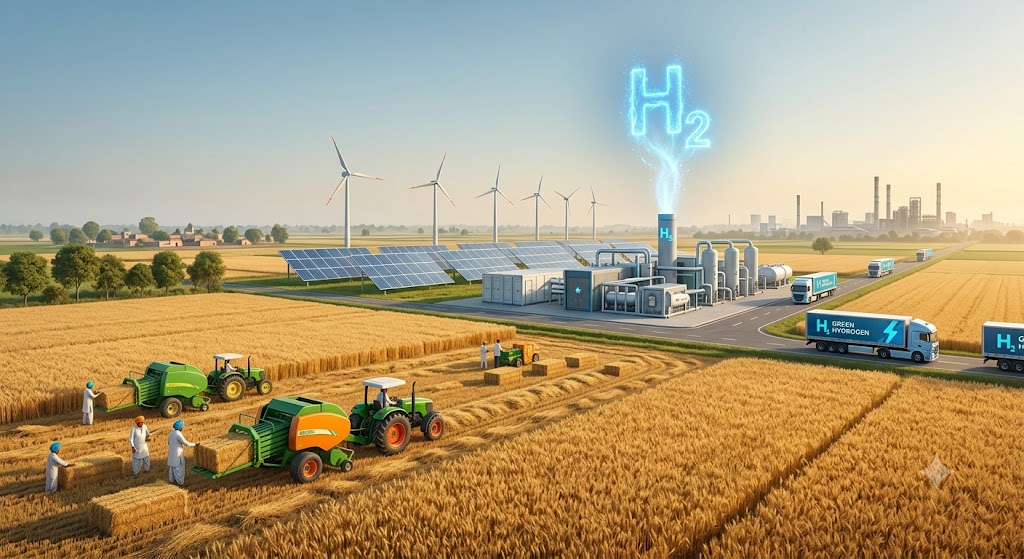
There is, indeed, a thermochemical pathway capable of integrating these two fragmented sectors into a single technical and strategic opportunity. Agricultural biomass can serve as a feedstock for hydrogen production. Depending on the conversion technology employed, one tonne of dry biomass can produce approximately 40–100 kilograms of hydrogen.
The principal advantage of biomass over other renewable feedstocks is that the resource is already geographically distributed across virtually every agricultural state in India, enabling decentralised production close to the source.
Technologies Worth Betting On
Not all biomass-to-hydrogen pathways are equally suited to Indian conditions. Three technologies stand out.
First, biomass gasification is the most mature technology. Agricultural residues are converted into syngas at high temperatures, followed by hydrogen separation. It integrates well with agri-processing clusters and, when combined with carbon capture, can produce carbon-negative hydrogen.
Second, anaerobic digestion with biogas reforming is the most immediately deployable option. Wet organic wastes—including cattle dung and agro-industrial effluents—are converted into biogas, which is subsequently reformed to produce hydrogen. This pathway builds directly on India’s existing compressed biogas infrastructure, requires moderate capital investment, and aligns naturally with village-scale energy systems.
Third, pyrolysis reforming offers a modular approach in which biomass is thermally decomposed to produce hydrogen precursors while generating biochar as a valuable co-product. Biochar improves soil fertility, can qualify for carbon credits, and transforms a hydrogen production facility into a regenerative agriculture asset.
All three technologies share a critical advantage over electrolysis: they are inherently decentralised and scalable through replication rather than concentration.
The Missing Middle
The opportunity for convergence exists, but the policy architecture does not—yet.
India’s National Green Hydrogen Mission remains overwhelmingly focused on renewable electricity-based electrolysis, while existing bioenergy schemes do not treat hydrogen as a priority end-use. There are no standardised biomass procurement contracts, no floor prices for hydrogen-oriented residue markets, and no dedicated financing mechanisms for decentralised biomass-to-hydrogen systems.
Meanwhile, the Ministry of New and Renewable Energy (MNRE), Ministry of Agriculture and Farmers Welfare (MoAFW), Ministry of Petroleum and Natural Gas (MoPNG), and Ministry of Power (MoP) each hold a part of the solution, yet no integrated coordination mechanism exists to bring these efforts together.
What Must Change
Four interventions are essential.
First, the National Green Hydrogen Mission must move beyond pilot projects and establish dedicated incentive streams for biomass- and waste-based hydrogen. Although these pathways are recognised in principle, financial support and deployment remain overwhelmingly focused on electrolysis.
Second, a dedicated component for decentralised hydrogen, analogous to SATAT for compressed biogas, should be established, with cooperative ownership at its core rather than as an afterthought.
Third, targeted financial instruments—including viability gap funding, credit guarantees, and interest subvention—should be specifically designed for small- and medium-scale biomass-to-hydrogen plants.
Fourth, a cross-ministerial coordination platform should be established to bring together all relevant ministries under a common deployment framework.
The Way Forward
India’s hydrogen future need not be confined to large industrial hubs. It can begin in its fields.
The biomass exists. The hydrogen ambition exists. What is needed now is the policy resolve to connect them.
The same seasonal cycle that engulfs northern India with particulate matter every winter can, with the right policy architecture, contribute to a decentralised hydrogen economy that reaches where electrolysers never will—the farm, the cooperative, and the rural cluster.
India has never lacked resources. It has often lacked the imagination to see them as assets rather than problems.
Crop residue is the latest test of that imagination. The resource is renewable. The policy window is not.
This article is authored by Bidisha Banerjee, Research Associate, Agriculture Policy, Sustainability and Innovation. In this article, she examines the potential of integrating agricultural biomass into India’s green hydrogen strategy to address crop residue burning while advancing a decentralised and inclusive clean energy transition.
Subscribe to our Newsletter
Subscribe today for free and stay on top of latest developments in Cleantech domain.