Beyond the Cylinder: Why Storage is the Missing Link in Clean Gas Transition
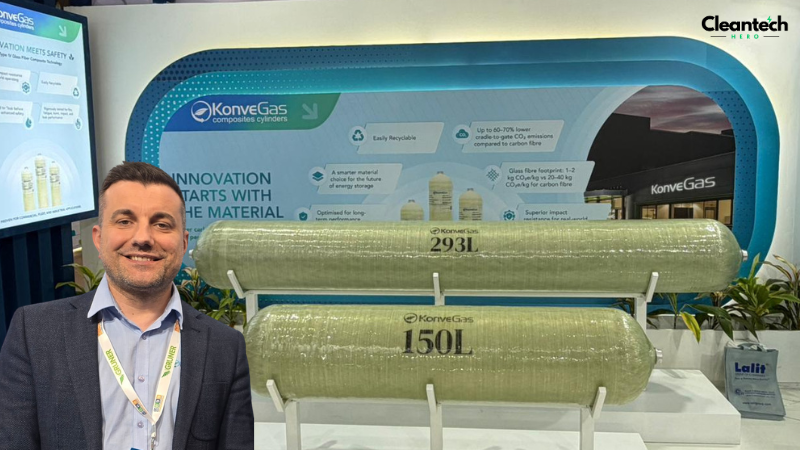
The interview of Alexander Enulescu, founder of KonveGas, looks at the importance of storage systems for making cleaner gases like CNG, biogas, and hydrogen practical and widely usable. It also explains that to truly understand how “green” these technologies are, we need to look at things like what materials they use, how they are manufactured, the emissions involved, and their overall impact across their full life cycle—not just how they perform when in use.
1. You’ve described storage as “the primary bottleneck” for clean gas adoption. Specifically, what part of the storage chain—vessel cost, weight, regulatory approval, or local manufacturing capacity—is the biggest constraint today, and how does that vary between CNG, biogas, and hydrogen?
It varies by fuel, but there’s a constraint people often overlook: the vessel itself.
For CNG and biogas, the technology is mature, so the visible constraints are weight and cost. But the deeper issue is the embedded carbon in the storage vessel. If you run renewable biogas but store it in cylinders made from fossil-based, high-emission materials that are produced through energy-intensive manufacturing, you haven’t eliminated emissions—you’ve simply relocated them from the tailpipe to the factory. The fuel is clean; the storage isn’t.
For hydrogen, the technical bar is higher still. Its physical properties demand more from materials, liner design, and pressure capability. But the same principle applies: a hydrogen vessel produced from fossil-based, energy-intensive materials carries the same embedded-emissions problem. Storing a zero-emission fuel in a high-carbon vesselundermines the very reason for switching to hydrogen in the first place.
So the real bottleneck isn’t a single cost line. It’s whether the entire storage chain, including the vessel, is genuinely low-carbon. Otherwise, clean gas becomes a way of relocating emissions rather than reducing them.
2. KonveGas builds Type 4 glass fiber composite cylinders rather than Type 3 (carbon fiber) or steel. For a business audience weighing total cost of ownership, what’s the economic case for glass fiber over carbon fiber, beyond the headline price difference?
The discussion should focus on total value rather than material cost alone.
Different materials bring different advantages. Some chase the lowest possible weight; others rely on established manufacturing routes. For gas storage, KonveGas advanced glass fiber composite cylinders strike the balance: weight savings, cost efficiency, durability, and proven high-pressure performance in one solution.
They also bring local and environmental advantages. KonveGas advanced glass fiber composite cylinders require lower energy use in production than more energy-intensive alternatives, which means lower embedded emissions. And because glass fiber can be sourced locally, it reduces dependence on imported materials, strengthens supply chain resilience, and keeps more value in the local economy.
This matters because total cost of ownership is never set by cylinder price alone. It is shaped by weight, payload, fuel efficiency, production energy, supply chain risk, service life, and the ability to deploy across a fleet or network in a financially realistic way.
So the case is not that glass fiber simply costs less. It is that it combines performance, safety, cost efficiency, and local value creation, while keeping embedded emissions lower than more energy-intensive alternatives.
3. Your cylinders are rated for over 25 years of service life. How does that durability translate into a concrete ROI argument for fleet operators or infrastructure developers comparing it against steel’s lower upfront cost?
When evaluating storage systems, the conversation should move beyond initial acquisition cost and focus on lifecycle economics.
A longer service life reduces replacement cycles, minimizes operational disruptions, and lowers long-term asset management costs. Combined with weight reduction and corrosion resistance, this can significantly improve the total cost of ownership over the life of the asset.
For fleet operators, higher efficiency and lower maintenance requirements contribute to stronger operational economics. For infrastructure developers, long-life storage systems provide greater asset utilization and investment stability.
The real value emerges when durability, operational performance, and lifecycle cost are evaluated together rather than focusing solely on upfront expenditure.
4. KonveGas serves three very different use cases—onboard vehicle storage, stationary storage, and transport modules. Do these require fundamentally different engineering approaches, or is it largely the same core technology adapted to different certifications?
The core technology platform remains similar, but each application requires dedicated engineering optimization and certification.
The fundamental challenge is always the same: storing gas safely, efficiently, and reliably under pressure. Onboard vehicle storage requires a strong focus on packaging, weight, crash safety, vibration, thermal exposure, and vehicle integration.
Stationary storage systems typically focus on capacity, long-term durability, and infrastructure integration. Transport modules must address logistics efficiency, transportation regulations, and repeated loading and unloading cycles.
While the underlying composite technology is shared, each application involves different performance requirements, regulatory frameworks, and certification standards.
5. Hydrogen storage carries different pressure and embrittlement challenges than CNG or biogas. What design or material adjustments does KonveGas make specifically for hydrogen applications, and is that market currently ahead of or behind CNG/biogas in commercial readiness?
Hydrogen introduces unique engineering challenges because of its small molecular size, high diffusivity, and demanding storage requirements.
This requires specialized liner technologies, optimized composite structures, advanced sealing solutions, and rigorous validation processes designed specifically for hydrogen service conditions.
From a market perspective, hydrogen remains behind CNG in terms of commercial maturity and infrastructure deployment. CNG has decades of operational experience, while biogas is benefiting from growing policy support and production investments.
Hydrogen’s long-term potential is significant, but the industry is still in the ecosystem-building phase. Storage technology, distribution infrastructure, and refueling networks will all need to expand substantially before hydrogen reaches widespread adoption.
6. You’re pursuing local manufacturing in India under the “Make in India” framework. What’s driving that decision—import costs and logistics, regulatory requirements, or proximity to OEM customers—and what’s your realistic timeline for a local production line?
India represents one of the world’s most dynamic clean-energy and mobility markets.
Local manufacturing supports multiple strategic objectives. It strengthens supply-chain resilience, reduces logistics complexity, improves responsiveness to customers, and aligns with national industrial-development priorities.
Proximity to OEMs, infrastructure developers, and clean-energy projects also enables stronger collaboration and faster market responsiveness.
We continue to evaluate opportunities and partnerships that support long-term manufacturing localization. The objective is to build a sustainable and scalable presence that grows alongside India’s clean-energy ecosystem.
7. India’s Compressed Bio-Gas and Green Hydrogen infrastructure is scaling quickly. From your vantage point at events like India Energy Week and the BBB Summit, where specifically is India’s storage infrastructure lagging behind the pace of production and demand?
India has made remarkable progress in supporting alternative fuel production, particularly in compressed biogas and hydrogen initiatives.
The next challenge is ensuring that storage, transportation, and distribution infrastructure expand at a comparable pace.
One area that requires attention is the movement of fuel between production centers and consumption hubs. Another is the continued expansion of refueling and distribution networks that can support growing demand from the transportation and industrial sectors.
The opportunity is significant because infrastructure investments made today will directly influence how rapidly clean fuels can achieve nationwide adoption.
8. You’ve claimed composite cylinders can cut logistics-related carbon footprint by up to 70%. Can you break down where those emissions savings actually come from—vehicle payload efficiency, fewer transport trips, manufacturing process, or end-of-life impact?
The reduction comes from several factors working together. A major part is the choice of raw materials and the energy intensity behind producing those materials. Advanced glass fiber composite technology can offer lower embedded energy and lower embedded emissions compared with more energy-intensive or fossil-based material alternatives.
Weight is another important factor. Compared with heavier storage solutions, a lighter composite cylinder system can improve payload efficiency, reduce fuel or energy use during transport, and, in some cases, reduce the number of trips required for the same delivered gas volume.
Manufacturing also matters. When glass fiber can be sourced locally, it can reduce dependence on imported high-energy materials, shorten supply chains, and support more local value creation.
End-of-life is part of the lifecycle discussion, but the main savings usually come from the combination of lower-impact raw materials, lower energy intensity in material production, lower cylinder weight, better transport efficiency, and longer service life.
The exact reduction depends on the application, cylinder size, transport distance, vehicle configuration, material sourcing, and local energy mix.
9. What does KonveGas’s testing and certification process look like in practice—fire, fatigue, burst, impact—and how do you communicate that safety profile to risk-averse industrial buyers who are used to steel?
Safety is the foundation of everything we do.
Composite cylinders undergo extensive testing and certification procedures designed to validate performance under demanding operating conditions. These evaluations typically include burst testing, pressure cycling, fatigue testing, impact resistance, environmental exposure assessments, and fire-related safety evaluations, depending on the applicable standards and intended application.
For industrial customers, transparency is essential. Safety is not communicated through marketing claims but through internationally recognized certifications, documented test results, engineering validation, and demonstrated operational performance.
At KonveGas, the objective is to ensure customers have confidence that advanced composite technologies can deliver both superior performance and uncompromising safety.
10. Looking three to five years out, what needs to happen at the policy or infrastructure level—in India or globally—for storage to stop being the bottleneck you describe?
The most important requirement is a coordinated ecosystem approach.
Governments, industry stakeholders, technology providers, and infrastructure developers must align investments across the entire value chain. Fuel production capacity alone is not enough. Storage, transportation, refueling infrastructure, standards, and certification frameworks must scale simultaneously.
Stable policy support, long-term infrastructure planning, and continued investment in advanced storage technologies will all play important roles.
Over the next three to five years, the countries that successfully integrate production, storage, and distribution into a unified clean-energy ecosystem will be the ones that achieve the fastest and most sustainable adoption of alternative fuels. For India, that opportunity is particularly significant given the scale of its energy transition ambitions.
Also Read: Thermal Runaway Is Not Just a Cell Problem: The Missing Link in BESS Safety Testing
Subscribe to our Newsletter
Subscribe today for free and stay on top of latest developments in Cleantech domain.