No Longer Scrap: How Spent EV Batteries Are Powering the Circular Economy
This article is authored by Avnish Bagaria, Co-Founder and Director of NavPrakriti Green Energies Pvt. Ltd. In this article, he explores how end-of-life EV batteries are driving the circular economy through recycling, second-life applications, and closed-loop supply chains, highlighting their role in advancing resource security and sustainable mobility.
The emergence of the EV has precipitated a secondary revolution, one that has garnered considerably less attention but is no less important. As the number of electric cars on the planet begins to increase, a new question arises: What will be done with the batteries when their lifecycle expires? The answer to this question has significant implications for the development of global industrial ecosystems. Rather than being wasted, used EV batteries are becoming an integral part of a developing circular economy.
The Scale of the Opportunity
First, let us talk about how big this problem is going to become and why there is such a need to develop a sustainable solution. According to estimates, worldwide battery demand exceeded 1 TWh in 2024, with over 85% of that coming from EVs. Given the current rate of growth, the number of available batteries is likely to increase sevenfold by 2030 and may approach millions of tonnes by 2040.
There is more than just waste involved here, since a 75 kWh EV battery cell contains more than $2,000 worth of valuable metals, including lithium, cobalt, nickel, and copper.
Markets are already beginning to respond to this trend. The global EV battery recycling market, forecast to be worth under $1 billion in 2024, could grow to almost $24.5 billion by 2035, marking an astonishing compound annual growth rate (CAGR) of over 40%. It seems that battery recycling will be among the fastest-growing sectors within the overall clean energy economy.
Turning Waste Into a Resource: The Circular Economy Approach
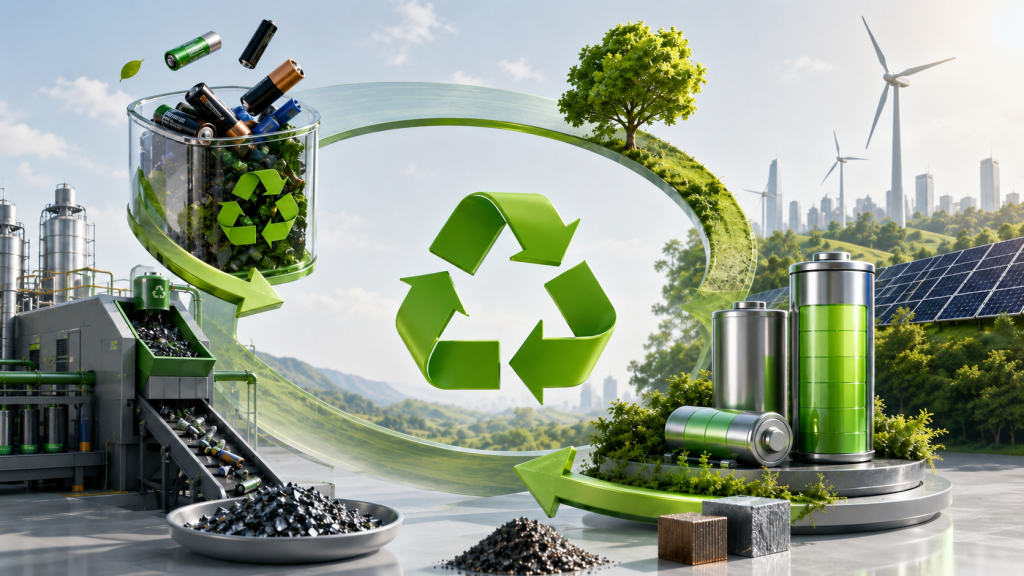
Historically, battery production and supply chains have followed a linear pattern: mine, produce, consume, and dispose.This model is becoming less and less viable. In addition to being resource-intensive, mining lithium, cobalt, and nickel carries serious geopolitical risks and has substantial negative environmental impacts. Recycling breaks the mold, reimagining “waste” as a sustainable source of vital minerals.
Thanks to advanced technological methods, 95–99% of cobalt and nickel and up to 95% of lithium can be extracted from batteries. What sets these materials apart from fossil fuels and allows for their effective recycling is their capacity for indefinite reuse without any decline in performance.
Second-Life Battery Economy
While recycling can serve as the end of a battery’s life, many batteries are currently finding a new lease on life through “second-life” applications. Despite having completed their lifecycle inside vehicles, EV batteries usually still retain around 60–80% of their original capacity, making them suitable for different purposes.
As a result, a second-life battery economy is emerging, in which EV batteries find a new home in stationary power storage units. There have already been initiatives aimed at using recycled EV batteries in microgrids powering thousands of people or stabilizing renewable energy generation.
Importantly, as renewable energy sources such as wind and solar become increasingly prevalent, grid storage is becoming crucial.
Industrial and Economic Changes
The circular battery economy goes beyond sustainable practices by reshaping industrial value chains. In the circular battery economy market, electric vehicles account for over 53%, demonstrating that they play an important role as both sources of waste and demand drivers.
A whole new ecosystem based on battery lifecycle management is developing, including collecting, analyzing, repurposing, recycling, and reusing materials within production processes. More than 90 recycling facilities have already been built, with a combined capacity of 1.6 million tonnes per year.
Both startups and well-established companies are investing in such practices, establishing closed-loop systems, in which materials obtained through recycling are reused to produce new batteries. Such an approach helps both conserve resources and strengthen supply chains amid the industry’s geopolitical fragmentation.
Structural Challenges on the Path to a Circular Economy
Though the concept holds promise, there are a number of structural challenges to the transition to a circular EV battery economy.
First, there is an obvious issue of timing, since battery production cycles typically last 8–12 years, meaning there will not be sufficient volumes available for recycling until at least a decade from now.
Second, economic considerations remain a major hurdle. The recycling process is capital-intensive, and price fluctuations could affect its cost efficiency. At the same time, the logistics of transporting and handling batteries also incur considerable costs.
Third, technological obstacles exist because there are many different EV batteries using various chemistries and technologies. Newer chemistries, such as LFP, are even less economically feasible to recycle because they contain fewer valuable materials.
Finally, even under optimistic assumptions, recycling will still contribute only a relatively modest share of the materials needed by 2040.
Policy, Innovation, and What Comes Next
It is only now that governments and policymakers have started playing an integral role in accelerating the adoption of circular solutions. For example, the European Union has mandated minimum recycling efficiency levels and increased recycled content requirements for future batteries. Policies of this nature are necessary to establish a market that supports and rewards recycling.
Moreover, innovation is progressing rapidly. The use of technologies such as battery passports and AI-driven diagnostics is enhancing the traceability and efficiency of the recycling process. Additionally, new technologies for more efficient and cost-effective material recovery continue to be researched and adopted.
Finally, businesses are also adapting their models. Automakers are exploring battery leasing and take-back programsthat help ensure a steady supply of batteries for recycling.
From Liability to Resource
The story of used battery packs from electric vehicles is changing in a fundamental way. What was once viewed as a liability is becoming a valuable resource.
Circular thinking is about creating economies where growth does not depend on the continual consumption of new resources. When it comes to electric vehicles, this means creating a closed-loop system, where batteries are continuously repurposed and recycled.
With the emergence of the mass EV market, companies and countries that succeed in building this circular model will gain a significant competitive advantage. Not only will they reduce their environmental impact, but they will also secure long-term access to critical resources.
Also Read: BESS 101 – Overview of Battery Energy Storage Systems (BESS) in India
Subscribe to our Newsletter
Subscribe today for free and stay on top of latest developments in Cleantech domain.